
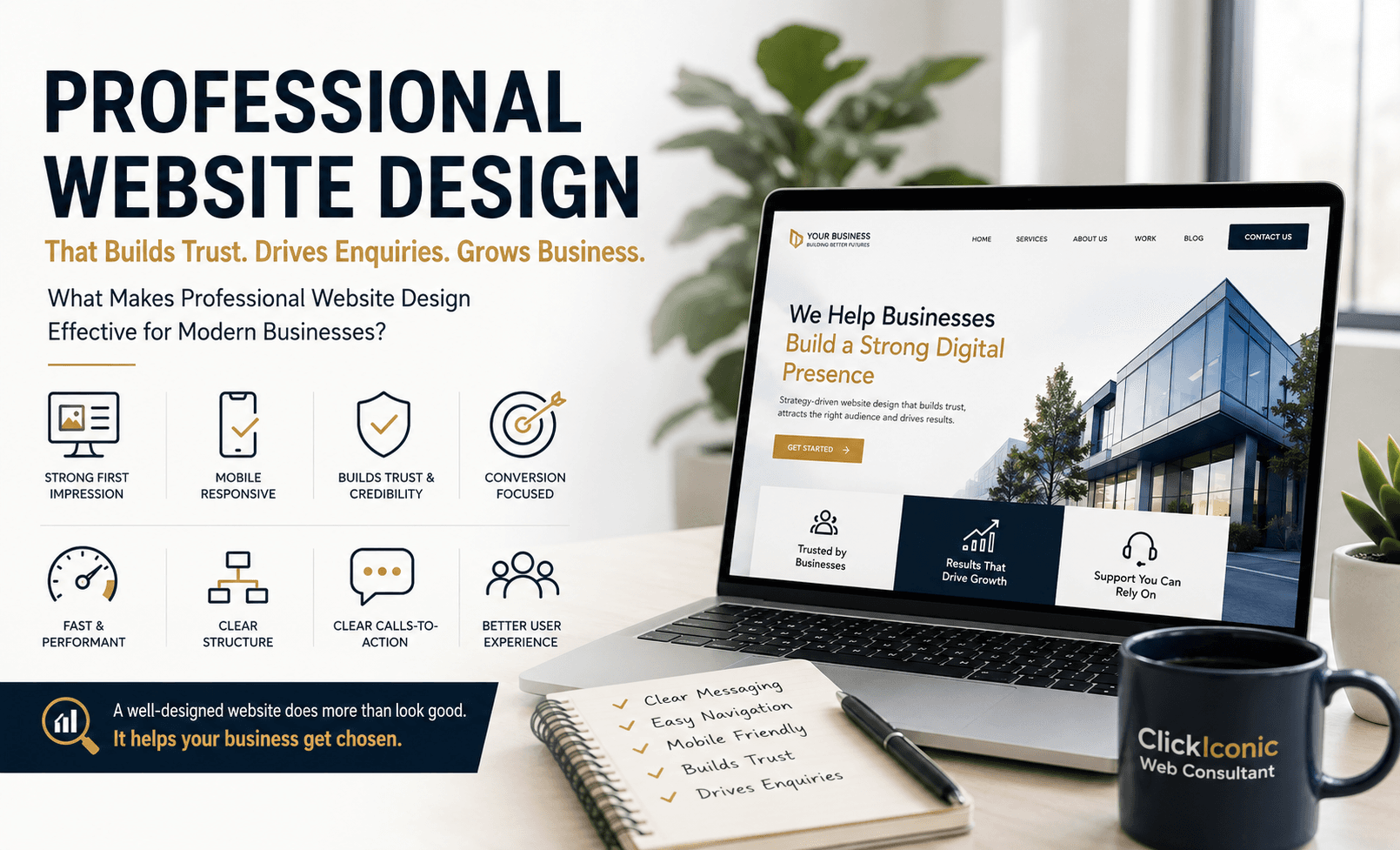
A business website can look modern and still fail to do its job.
The colours may be attractive. The images may be high quality. The animations may feel impressive. The layout may even look better than many competing websites. But if a visitor cannot quickly understand what the business does, who it helps, why they should trust it, or what they should do next, the design is not doing enough.
This is what makes professional website design different from simply creating a visually attractive website.
A professional website has to work on several levels at the same time. It needs to create a strong first impression, communicate clearly, feel easy to use, work comfortably on mobile devices, reinforce trust, load efficiently, and guide visitors towards an appropriate next step.
That becomes especially important for businesses selling services rather than simple products. A potential client may not be ready to buy immediately. They may first want to understand the business, compare alternatives, check experience, look for proof, and decide whether the company feels credible enough to contact.
The website therefore becomes part of the decision-making process.
Good website design understands this process. It does not treat every page as a collection of visual elements. Instead, the design connects structure, content, usability, credibility, and conversion into one experience.
For modern businesses, that is the real purpose of professional website design: not simply to make a business look professional, but to make it easier for the right people to understand, trust, and engage with the business.
What Is Professional Website Design?
Professional website design is the process of creating a website that combines visual quality with clarity, usability, credibility, performance, and business purpose.
The word professional is often used to describe websites that simply look polished. But visual polish is only one part of the equation.
A genuinely professional website should feel appropriate for the business and its audience. It should communicate the right message, present information clearly, make navigation straightforward, and provide a consistent experience across devices.
For a service business, professional website design also has to support trust. Visitors may not be able to evaluate the actual service immediately, so the website becomes one of the places where they look for evidence of experience, expertise, reliability, and professionalism.
This means good design decisions are connected to business decisions.
The layout affects how information is understood. Typography affects readability. Navigation affects usability. Images affect perception. Content affects clarity. Calls-to-action affect the next step. Performance affects whether visitors stay engaged.
Professional website design brings these elements together rather than treating them as separate tasks.
- ✓Clear business positioning
- ✓Strong visual hierarchy
- ✓Easy navigation
- ✓Readable content
- ✓Responsive mobile experience
- ✓Visible credibility
- ✓Clear calls-to-action
- ✓Good website performance
- ✓Consistent visual presentation
- ✓A logical customer journey
In simple terms, a professional website should look credible, feel easy to use, communicate clearly, and support what the business is trying to achieve.
What Are the Characteristics of a Professional Website?
A professional business website usually has several qualities working together rather than relying on one impressive design element.
There is no single visual style that makes a website professional. A corporate website, travel website, consultancy website, and recruitment website may all look very different.
What they can share is clarity, consistency, usability, credibility, and purpose.
A professional website does not force visitors to understand how the website works. It guides them naturally through the information they need.
The strongest websites also avoid unnecessary complexity. Every section, image, animation, button, and page should have a reason for being there.
For example, a safari operator may need strong destination imagery and detailed itinerary information, while a recruitment company may need to communicate expertise, process, locations, and reliability. Professional design adapts to those needs rather than applying the same visual formula to every business.
The best professional website design is not necessarily the most complicated. It is the design that makes the right experience feel simple.
Why First Impressions Matter
A website often introduces a business before the business has an opportunity to speak directly with a potential customer.
Visitors arrive with very little context. They may have discovered the business through Google, a recommendation, social media, a directory, or a link from another website.
The first screen therefore has an important job. It needs to establish relevance quickly enough that the visitor has a reason to continue.
A strong first impression does not require dramatic animation or an unusual layout. It usually comes from a combination of clear messaging, appropriate imagery, visual hierarchy, and confidence in presentation.
Imagine a safari operator whose homepage opens with a beautiful wildlife video but takes several seconds to explain where they operate, what kind of safaris they offer, or how a traveller can enquire. The website may look premium, but the experience can still create uncertainty.
The same principle applies to a consultant, recruitment company, education provider, or professional service business. Visitors need to understand relevance before they can appreciate the design.
The problem with many websites is that the first screen is designed around the business rather than the visitor.
Large statements about being innovative, world-class, or passionate may sound impressive, but they do not necessarily tell visitors what the business actually does or why it matters to them.
A better first impression starts with relevance and clarity.
The goal of a first impression is not to impress visitors for a few seconds. It is to give the right visitors a reason to keep exploring.
Design and Usability Must Work Together
A website can be visually impressive and still be difficult to use. Professional website design has to balance appearance with usability.
Design determines how information is presented, but usability determines how easily people can interact with that information.
A beautiful website with confusing navigation is not a successful website. A modern interface with tiny text is not a good experience. A creative homepage that hides important information behind animations may look interesting but create unnecessary friction.
Good design helps visitors understand the structure of the page.
Headings show what each section is about. Spacing separates ideas. Typography creates hierarchy. Buttons look interactive. Navigation provides orientation. Images support the message instead of competing with it.
This is why professional web design should always consider what happens after the visual design is created.
Can someone find the service they are looking for? Can they understand the content? Can they return to another page easily? Can they complete the enquiry form without frustration?
These questions are part of design, not separate from it.
Good design attracts attention, but good usability helps visitors turn that attention into understanding and action.
Why Mobile Responsiveness Is Essential
A professional website cannot be considered complete if the experience only works well on a desktop screen.
People access websites from phones, tablets, laptops, and desktop computers. Each screen creates different limitations and opportunities.
A responsive website adapts its layout to those different environments rather than simply shrinking the desktop version.
This affects much more than screen width. Navigation may need to change. Text may need different spacing. Buttons need to remain easy to tap. Images should scale correctly. Forms need to remain usable. Sections may need to stack differently.
Mobile visitors are also less likely to tolerate unnecessary friction. If the website requires excessive scrolling, tiny controls, awkward menus, or difficult forms, the experience can quickly become frustrating.
For service businesses, this can directly affect enquiries. A potential customer may discover a business on a phone and decide whether to contact it without ever opening the desktop version.
Mobile responsiveness should therefore be treated as part of the core design rather than a final technical adjustment.
A professional responsive website should feel intentionally designed for mobile, not like a desktop website that happens to fit on a phone.
How Website Design Builds Trust and Credibility
For trust-based businesses, the website has an important role in helping potential customers decide whether the business deserves consideration.
Visitors cannot always evaluate a service before contacting the provider. Instead, they look for signals that reduce uncertainty.
Professional presentation is one of those signals, but it is not enough on its own.
A website can strengthen credibility by making real evidence visible. This might include client work, case studies, testimonials, reviews, experience, team information, certifications, partnerships, locations, processes, or useful information that demonstrates expertise.
The important point is that trust should be supported by evidence rather than exaggerated claims.
Saying that a company is the best or most trusted business does not automatically make it credible. Showing relevant experience and explaining how the business works gives visitors something they can actually evaluate.
Design helps organise this evidence so that visitors encounter it at the right points in their journey.
For example, a case study may be more persuasive after a service has been explained. A testimonial may be more useful near a call-to-action. Team information may matter when visitors are deciding whether they are comfortable making contact.
This is particularly important for businesses where the first sale is based on confidence. A professional digital presence cannot manufacture credibility, but it can make genuine credibility much easier to recognise.
Real Experience
Show relevant projects, years of experience, specialist knowledge, or industry understanding.
Proof of Work
Use case studies, portfolio examples, testimonials, reviews, or results where appropriate.
People Behind the Business
Introduce the people involved when personal credibility and relationships matter.
Specific Information
Provide useful details about services, processes, locations, industries, or what happens after an enquiry.
Professional Presentation
Use a clear and consistent website experience that reflects the seriousness of the business.
A website cannot manufacture genuine credibility, but professional website design can make existing credibility much easier for visitors to see and understand.
Why Clear Calls-to-Action Matter
A visitor should not have to guess what they are supposed to do after understanding a page.
Calls-to-action are often treated as simple buttons, but their real purpose is to provide direction.
The appropriate CTA depends on the business and the visitor's level of readiness. Someone researching a complex service may not be ready to buy immediately. They may be ready to discuss a project, request information, view a case study, or schedule a consultation.
That is why adding the same 'Contact Us' button everywhere is not always the strongest approach.
The call-to-action should match the context of the page and the question the visitor is likely to have next.
A service page might encourage a consultation. A case study might encourage visitors to discuss a similar project. A travel page might encourage an itinerary enquiry. An educational article might guide the reader towards a relevant service or consultation.
The CTA should feel like a natural continuation of the visitor's journey rather than an interruption.
A clear CTA does not force visitors to convert. It simply makes the next step easier to understand when they are ready.
Why Website Performance Is Part of Good Design
Professional website design should not be judged only by how a page looks after everything has loaded.
A visually impressive website that loads slowly can create a poor experience before visitors have an opportunity to appreciate the design.
Large images, unnecessary scripts, excessive animations, poorly optimised assets, and inefficient implementation can all contribute to a slower experience.
Performance is therefore connected to design decisions from the beginning.
Images should be appropriate for their purpose. Animations should add value rather than exist simply because they are possible. Fonts and assets should be handled efficiently. The page should prioritise important content rather than making visitors wait for decorative elements.
Performance also affects how professional the website feels. When pages respond quickly and interactions feel stable, the overall experience becomes more comfortable.
For businesses, this matters because every unnecessary delay creates another opportunity for a visitor to leave before reaching the information or action that matters.
Performance is not separate from professional website design. A fast, stable, usable experience is part of what makes the design effective.
What Is Conversion-Focused Website Design?
Conversion-focused website design does not mean turning every page into a sales pitch. It means designing the experience around meaningful visitor actions.
Different businesses have different definitions of conversion.
For an ecommerce business, conversion may mean completing a purchase. For a travel company, it may mean requesting an itinerary or starting a booking conversation. For a consultant, it may mean scheduling a consultation. For a recruitment company, it could mean an employer enquiry or candidate application.
The design should therefore support the specific journey that leads towards that action.
A visitor usually needs more than a button before they are ready to convert. They need clarity about the service, confidence in the business, answers to important questions, and an easy way to continue.
This creates a progression: attention, understanding, relevance, trust, confidence, and action.
Conversion-focused design considers each stage instead of treating the CTA as the entire conversion strategy.
This is one reason professional website design services should begin with understanding the business and its audience rather than immediately choosing colours, layouts, or animations.
Better conversion often comes from better clarity and confidence rather than more aggressive sales messaging.
Why Content and Design Cannot Be Separated
Even the strongest visual design cannot compensate for unclear website content.
Many businesses start a website redesign by discussing layouts, colours, images, and animations. These decisions matter, but they cannot solve every website problem.
If visitors do not understand what a business does, changing the layout will only move the confusion around.
Professional website design therefore needs to work with content.
The headline should communicate the right idea. Service pages should explain what is actually offered. Supporting sections should answer questions. Case studies should provide evidence. Calls-to-action should explain the next step.
Content also needs to be structured for scanning. Visitors often do not read every word on a page. Headings, short paragraphs, lists, visual hierarchy, and relevant examples help them find the information that matters.
This is especially important for search visibility. A page designed around a keyword but lacking useful information is unlikely to provide a strong experience for either search engines or readers.
The better approach is to create genuinely useful content around the topic and then organise it so that both people and search engines can understand the page.
In other words, professional website design is not just about deciding where content sits. It is about making the right information easier to understand at the right moment.
Good professional website design gives useful content the structure and presentation it needs to be understood.
Common Professional Website Design Mistakes
Some websites look modern but still create unnecessary problems for visitors and the business.
The most common mistakes are often not dramatic. They are small decisions that accumulate into a frustrating experience.
A website may use beautiful imagery but provide little information. It may have impressive animations but unclear navigation. It may have multiple CTAs but no clear primary action. It may look excellent on desktop but be difficult to use on mobile.
Another common problem is assuming that a website needs to be rebuilt simply because it looks dated. Sometimes the deeper issue is unclear positioning, weak content, poor structure, or an inefficient customer journey.
These issues matter because professional design is about the complete experience rather than isolated visual details.
The solution is not to remove all creativity. It is to make creativity serve clarity, usability, credibility, and business purpose.
When Should a Business Consider a Website Redesign?
A website redesign makes sense when the current website no longer represents the business or supports the customer journey effectively.
A redesign should not happen simply because the website is a few years old. Technology and visual styles change, but age alone does not tell you whether the website is failing.
The more useful question is whether the website still works for the business it represents today.
A business may have changed its services, audience, positioning, reputation, expertise, or market. If the website still communicates an older version of the business, the digital experience can create the wrong impression.
Other signs may be more practical. Important information may be difficult to find. The mobile experience may be poor. The website may receive traffic without generating useful enquiries. The design may no longer reflect the quality of the business.
In these situations, a strategic website redesign can address more than appearance.
But redesigning everything is not always the right answer. An existing website may already have valuable content, useful search visibility, established branding, or pages that are performing well. A proper review should identify what needs to change before deciding what needs to be rebuilt.
Redesign for a Reason
A redesign should have a clear purpose. The goal should not simply be to make the website look newer, but to improve the experience the business provides online.
- ✓Improve positioning
- ✓Clarify messaging
- ✓Strengthen website structure
- ✓Improve usability
- ✓Improve mobile experience
- ✓Make credibility easier to recognise
- ✓Improve content
- ✓Clarify conversion paths
- ✓Improve performance
- ✓Bring the website back in line with the current business
A successful website redesign is not simply a visual upgrade. It is an opportunity to make the website more useful, credible, and effective.
Does Your Website Look Professional to a New Visitor?
Before deciding that you need a new website, look at your current website as if you were discovering the business for the first time.
If several of these answers are no, the problem may not simply be that your website needs a more modern visual style. It may need clearer positioning, better content, improved UX, stronger credibility, better performance, or a more deliberate conversion journey.
How Is Your Website Performing?
A quick score can help you understand whether your website has a strong foundation or whether it may be creating unnecessary friction for potential customers.
The score is not a technical website audit and it is not intended to replace analytics or usability testing. Its purpose is simpler: to encourage you to look at the website from the perspective of someone who does not already know your business.
If several answers are no, resist the temptation to immediately assume that you need more animations, more pages, or a complete rebuild.
The more useful question is: what is causing the gap between the quality of the business and the experience the website currently provides?
If you are unsure what should be improved first, a strategic website review can help separate cosmetic issues from deeper problems in positioning, content, UX, credibility, performance, structure, and conversion.
Building a Professional Website That Supports the Business
The strongest professional websites connect business goals with the experience visitors receive online.
A professional website should not exist simply because every business is expected to have one. It should have a purpose.
That purpose might be to generate enquiries, establish credibility, explain complex services, support sales conversations, attract new customers, generate bookings, or provide information that helps potential customers make decisions.
Once the purpose is clear, design decisions become easier to evaluate.
Does this section help visitors understand something important? Does this image support the message? Does this navigation structure make sense? Does this CTA provide a useful next step? Does this page work on mobile? Does the website make the business easier to trust?
These are much more useful questions than simply asking whether the website looks modern.
This is also where a website design consultant can provide value beyond visual design. The role is not simply to decide how pages should look, but to understand the business, audience, positioning, content, structure, UX, credibility, and conversion journey before deciding what the website should become.
At ClickIconic, we approach website projects from this broader perspective. We focus on helping trust-based service businesses create professional digital experiences that communicate credibility before the first conversation.
That means looking at the business, audience, positioning, content, structure, UX, credibility, and conversion journey before deciding what the website should look like.
We also do not believe every business automatically needs a complete redesign. Sometimes the existing website has valuable content, useful search visibility, a strong brand foundation, or other assets worth preserving.
The right solution may therefore be a redesign, but it may also be a focused improvement plan.
The important question is not whether the website can be made more impressive. It is whether it can be made more useful.
- ✓Clear positioning
- ✓Strong visual hierarchy
- ✓Useful website structure
- ✓Relevant and well-organised content
- ✓Professional visual presentation
- ✓Simple navigation
- ✓Good user experience
- ✓Mobile responsiveness
- ✓Visible credibility
- ✓Good website performance
- ✓Clear calls-to-action
- ✓Conversion-focused customer journeys
If you are planning a new website or considering a redesign, start by looking beyond visual style. Consider what your website needs to communicate, what visitors need to understand, where credibility needs to be demonstrated, and what action you want the right visitors to take.
You can also explore the Professional Website Design for Businesses section on the ClickIconic homepage to understand how professional website design fits into a broader digital presence.
For businesses that are unsure whether they need a complete redesign, a strategic review can help identify whether targeted improvements or a larger redesign would make more sense.
Professional Website Design Checklist
First Impression
- ✓The homepage immediately communicates what the business does
- ✓The main message is relevant to the target audience
- ✓The visual presentation feels consistent and professional
- ✓The imagery supports the business rather than distracting from it
- ✓The page has a clear visual hierarchy
Usability
- ✓Navigation is simple and logical
- ✓Important information is easy to find
- ✓Content is easy to scan
- ✓Typography is comfortable to read
- ✓Buttons and links are easy to recognise
- ✓The website does not create unnecessary friction
Mobile Experience
- ✓The website works well on phones
- ✓Navigation is easy to use on smaller screens
- ✓Buttons are easy to tap
- ✓Images scale correctly
- ✓Forms remain comfortable to complete
- ✓Important information is still easy to access
Trust and Credibility
- ✓Relevant experience is visible
- ✓Portfolio or project examples are easy to find
- ✓Reviews or testimonials are presented where useful
- ✓The people behind the business are introduced where appropriate
- ✓Important business information is easy to verify
- ✓The website avoids exaggerated or unsupported claims
Conversion
- ✓Primary calls-to-action are clear
- ✓CTAs match visitor intent
- ✓Visitors understand what happens after clicking
- ✓Important pages provide a logical next step
- ✓The enquiry process is straightforward
- ✓The website does not overwhelm visitors with competing actions
Performance
- ✓Images are appropriately optimised
- ✓Pages load efficiently
- ✓Animations are used selectively
- ✓Interactions feel stable
- ✓The website works well across devices
- ✓Technical implementation does not unnecessarily slow the experience
Frequently Asked Questions
Key Takeaways
- ✓Professional website design is about far more than making a website look modern.
- ✓The best websites create a clear and relevant first impression.
- ✓Design and usability should work together rather than compete with each other.
- ✓Mobile responsiveness is a core part of a professional website experience.
- ✓Trust should be supported through real evidence such as experience, projects, reviews, testimonials, and useful information.
- ✓Clear calls-to-action help visitors understand what they can do next.
- ✓Website performance is part of the user experience and should influence design decisions.
- ✓Conversion-focused design is about guiding visitors naturally rather than aggressively pushing them to buy.
- ✓Content and design need to work together because visual presentation cannot fix unclear messaging.
- ✓A website redesign should solve a real business or customer experience problem rather than simply change the appearance.
- ✓A professional business website should make the business easier to understand, easier to trust, and easier to engage with.
- ✓The most important question is not whether your website looks modern. It is whether your website is doing its job.
Is Your Website Really Representing the Quality of Your Business?
Your website may not need more pages, more animations, or simply a newer visual style. It may need clearer positioning, stronger content, better usability, stronger credibility, improved performance, or a clearer path from interest to enquiry. ClickIconic helps trust-based service businesses create professional digital experiences that build confidence before the first conversation. If you are considering a new website or redesign, start by understanding what your website actually needs to do differently.
Request a Website Review