
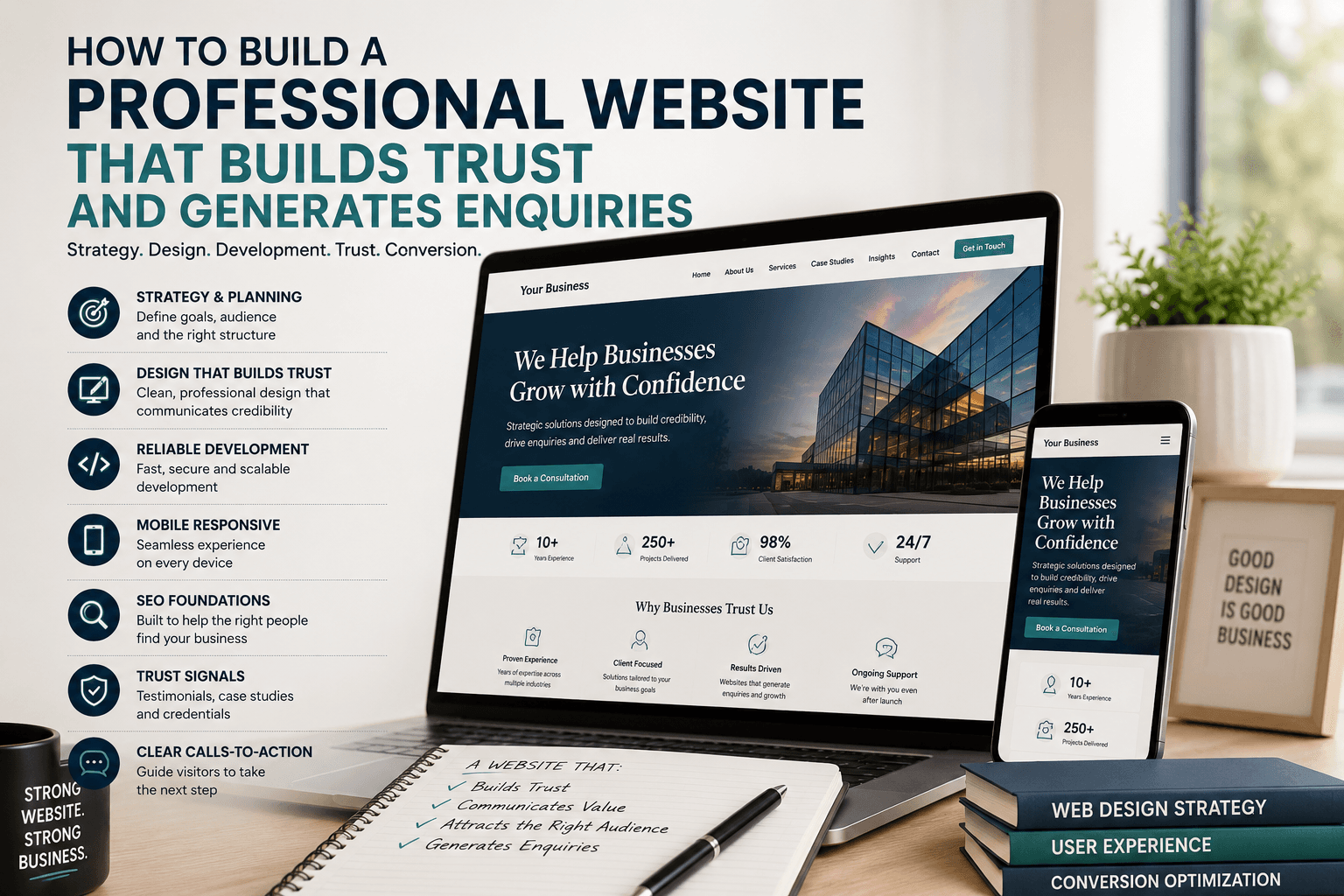
For many businesses, a website is one of the first places potential customers go when they want to understand who they are dealing with.
Before someone sends an enquiry, requests a quote, books a consultation, or starts a conversation, they may spend several minutes reviewing your services, experience, content, reviews, contact information, and overall presentation.
During that short visit, they are making a judgement that your website cannot directly ask them to make: Can I trust this business?
That question matters because visitors cannot automatically see the experience, expertise, customer service, or attention to detail that exists inside your company. Your website has to communicate enough of those qualities to make the business feel credible before the first conversation takes place.
This is why learning how to build a professional website involves much more than choosing a visual style. It requires business website strategy, website planning, useful content, thoughtful design, reliable website development, mobile responsiveness, SEO foundations, trust signals, clear calls-to-action, and proper testing.
The objective is not simply to create a website that looks professional. It is to create a digital experience that makes the business easier to understand, easier to trust, and easier to contact.
If your current website looks outdated, communicates your services poorly, hides important information, or receives visitors without generating meaningful enquiries, the problem may not be your business. It may be the way your business is presented online.
Start With Planning Before Designing the Website
One of the most common mistakes businesses make is starting with the visual design before deciding what the website needs to achieve.
A professional website should begin with a clear understanding of the business, its audience, its services, its positioning, and the actions visitors should take.
Good website planning gives the project a strategic foundation. Without it, businesses can end up with attractive pages that communicate the wrong information or make visitors work too hard to understand what the company actually offers.
Before opening a design file or choosing a visual direction, identify the purpose of the website and the role it should play in the customer journey.
A service business may want to generate consultation enquiries. A travel company may want visitors to request an itinerary. A recruitment company may need employers to request workforce solutions. A consultant may want potential clients to begin a conversation.
The structure, content, design, and calls-to-action should support that purpose.
Planning also helps prevent unnecessary pages, confusing navigation, duplicated information, and content that does not contribute to the visitor journey.
- ✓Understand the business and its positioning
- ✓Identify the target audience
- ✓Define the main business goals
- ✓Understand the problems visitors are trying to solve
- ✓Identify the primary conversion action
- ✓Review competitors and market expectations
- ✓Determine what information visitors need before enquiring
- ✓Define the role of each major website page
Start With These Questions
Before designing the website, answer a few fundamental questions about the business and the visitor journey.
- ✓Who is this website for?
- ✓What does the business help customers achieve?
- ✓Why should someone choose this business?
- ✓What information does a visitor need before contacting the business?
- ✓What action should a qualified visitor take?
- ✓What should the website communicate within the first few seconds?
Good planning makes every stage that follows more focused. It helps ensure that the final website is built around business goals rather than simply around visual preferences.
Define What the Website Needs to Achieve
A professional website should have a clear purpose. Without clearly defined goals, it becomes difficult to know whether the website is actually working.
Different businesses need different outcomes from their websites. Some need more enquiries, while others may focus on consultation bookings, quote requests, applications, calls, or direct sales.
The website should therefore be designed around the actions that matter most to the business.
For example, a consultancy website may prioritise consultation requests, while a travel business may focus on itinerary enquiries. A recruitment company may need employers to request staffing support, while an education consultant may want prospective students to begin an enquiry.
Defining these goals early helps determine what information should appear on the homepage, which pages deserve the most attention, and where calls-to-action should appear.
It also prevents the website from becoming a collection of pages with no clear direction.
A website becomes more effective when every major page contributes to a clear business objective.
Build a Clear Sitemap and Website Structure
Once the goals are clear, the next step is deciding how the information will be organised.
A website sitemap provides the structural foundation of the project. It defines the main pages, supporting pages, navigation hierarchy, and relationships between different areas of content.
Without a clear structure, important information can become buried, pages can overlap, and visitors may struggle to understand where they should go next.
A professional website should make the most important information easy to discover.
The sitemap should reflect the way visitors think about the business rather than simply the way the business is internally organised.
For example, instead of forcing visitors to understand internal company departments, the website can organise information around services, solutions, industries, expertise, proof, and next steps.
A clear website sitemap also gives search engines a better understanding of how important pages relate to each other.
- ✓Homepage
- ✓About or company information
- ✓Services or solutions
- ✓Industries or audiences served
- ✓Success stories or case studies
- ✓Insights or resources
- ✓Contact or consultation page
- ✓Privacy Policy
- ✓Terms and Conditions
A Good Sitemap Should Make Three Things Clear
Visitors should be able to understand where they are, where they can go next, and where they should go when they are ready to take action.
- ✓What the business offers
- ✓Why the business is credible
- ✓How to start a conversation
A well-planned sitemap improves usability, content organisation, SEO structure, and the overall visitor journey.
Plan Content Around Visitor Questions
Design creates the first impression, but content is what helps visitors understand the business and decide whether it is relevant to them.
Website content should not simply describe what the business does. It should answer the questions potential customers have before making an enquiry.
Visitors want to know what you offer, who you help, what makes you different, whether you have relevant experience, what the process looks like, and what happens after they contact you.
Good website content makes those answers easy to find.
The strongest content is specific rather than generic. Instead of saying that a business provides high-quality services, explain what those services involve, who they are designed for, and what experience the business brings.
This is where a strong website content strategy becomes valuable. It connects business expertise with the questions people actually ask.
Content should also be organised into clear sections because many visitors scan headings, short paragraphs, bullet points, images, proof points, and calls-to-action before deciding whether to read further.
Write for the Visitor, Not Just the Business
The best website content connects what the business offers with the problem, goal, or concern the visitor already has.
- ✓Explain benefits clearly
- ✓Use specific language
- ✓Avoid unnecessary jargon
- ✓Break long content into scannable sections
- ✓Answer common questions
- ✓Use proof where relevant
- ✓Connect content naturally to the next step
Useful content reduces uncertainty. When visitors can quickly find the answers they need, they are more likely to continue exploring and eventually enquire.
Design the Website to Communicate Trust
Professional website design is not simply about making pages look attractive. It is about creating a visual experience that communicates clarity, credibility, and confidence.
Visitors often make quick judgements about a business based on the appearance and usability of its website.
A cluttered layout, inconsistent typography, poor spacing, low-quality imagery, confusing navigation, or outdated visual style can make a capable business appear less professional than it actually is.
Effective business website design should balance visual credibility with clarity, usability, accessibility, and the actions visitors need to take.
Good design creates visual hierarchy. It helps visitors understand what is most important, what they should read next, and where they can take action.
Typography, spacing, imagery, colour, layout, buttons, navigation, and page structure should work together rather than compete for attention.
For businesses comparing website design options, the right website design for businesses is not necessarily the most elaborate one. It is the design that makes the company's value clear to the people it wants to reach.
The design should also reflect the personality and positioning of the business. A professional website does not need to look corporate or generic. It needs to look intentional and appropriate for the audience it serves.
Good design should make the business feel credible while making the website easier to understand and use.
Develop the Website for Performance and Reliability
Once the structure, content, and design are defined, the website needs to be developed in a way that makes the experience reliable, responsive, and efficient.
Website development is where the planned experience becomes a working website. This stage includes implementing layouts, interactions, navigation, forms, integrations, responsive behaviour, and technical functionality.
A professional website should not only look correct in a design mockup. It should work correctly in real-world conditions.
Pages should load efficiently, navigation should work consistently, forms should submit correctly, links should lead to the right destinations, and interactive elements should behave predictably.
Professional website development should therefore support both the user experience and the business objectives established during planning.
Performance also matters because slow or unreliable pages can create frustration and reduce the likelihood that visitors will continue exploring.
The technical implementation should remain focused on the experience the visitor is supposed to receive rather than adding complexity simply because a technology allows it.
Good website development turns strategy and design into a reliable digital experience that visitors can actually use.
Make Mobile Responsiveness a Priority
A professional website needs to work well on mobile devices, not simply shrink down from the desktop version.
Many potential customers discover and research businesses using smartphones. If the website is difficult to navigate on a smaller screen, the business can lose credibility before the visitor has even explored its services.
A mobile responsive website should adapt layouts, typography, images, navigation, forms, and content spacing to different screen sizes.
The mobile experience should also consider how people actually interact with their phones. Buttons need to be easy to tap, important information should remain accessible, and forms should not require unnecessary effort.
Mobile responsiveness is therefore part of both usability and credibility.
A website that works beautifully on desktop but feels frustrating on mobile is not yet a fully professional website.
A Strong Mobile Experience Should Provide
Visitors should be able to understand the business and take important actions without struggling with the interface.
- ✓Readable typography
- ✓Simple navigation
- ✓Comfortable spacing
- ✓Fast-loading content
- ✓Easy-to-use buttons
- ✓Mobile-friendly forms
- ✓Clear calls-to-action
Common Mobile Website Problems
- ✓Text that is too small to read comfortably
- ✓Buttons that are difficult to tap
- ✓Navigation that is confusing
- ✓Images that crop incorrectly
- ✓Content overflowing horizontally
- ✓Forms that are difficult to complete
- ✓Slow-loading mobile pages
- ✓Important information pushed too far down the page
- ✓Excessive animations or interactions
Mobile responsiveness is not an optional enhancement. It is part of delivering a professional digital presence.
Build Strong SEO Foundations From the Start
Search engine optimisation should not be treated as something added after the website is finished. Important SEO foundations should be considered during planning, content creation, design, and development.
A professional website needs to be understandable not only to visitors but also to search engines.
Website SEO foundations help search engines understand what each page is about, which topics the website covers, and how different pages relate to each other.
This starts with clear page topics and useful content. Technical elements such as page titles, meta descriptions, headings, URLs, internal links, image alt text, structured data where appropriate, and performance also contribute to the foundation.
SEO does not mean filling pages with keywords. The goal is to create useful pages that clearly address the questions and needs of people searching for the business's services.
Building these foundations from the beginning is generally more effective than trying to restructure the entire website after launch.
Strong SEO foundations make the website easier for search engines to understand while keeping the primary focus on useful content for real visitors.
Use Trust Signals to Reduce Visitor Uncertainty
A professional appearance can create a good first impression, but visitors often need evidence before they are ready to enquire.
Website trust signals provide that evidence. They help visitors understand that the business is real, experienced, established, and capable of delivering what it promises.
Different businesses will have different trust signals. A consultancy may use client results and case studies. A travel business may use traveller reviews and destination expertise. A recruitment company may highlight experience, clients, processes, and professional credentials.
For example, a travel website should not rely on beautiful photography alone. Visitors may also want to understand the company's expertise, destinations, experience, process, and what happens after they enquire.
Likewise, a workforce or recruitment business may need to communicate reliability, experience, process, and the people behind the service before an employer feels comfortable starting a conversation.
The important point is that trust signals should be genuine and relevant.
Simply claiming to be the best business in the industry is less convincing than showing evidence that supports the claim.
Trust signals should also appear throughout the website rather than being hidden on one page.
Testimonials and Reviews
Real customer experiences provide social proof and help potential customers understand what working with the business is actually like.
- ✓Customer testimonials
- ✓Third-party reviews
- ✓Client feedback
- ✓Specific customer experiences
Authentic reviews can reduce uncertainty by showing that other customers have already trusted the business.
Case Studies and Success Stories
Case studies demonstrate how the business has helped real customers rather than simply describing what it claims to do.
- ✓Real projects
- ✓Customer challenges
- ✓Solutions provided
- ✓Results or outcomes
- ✓Project context
Specific examples can make expertise much more believable than generic claims.
Team and Experience
Introducing the people behind the business makes the organisation feel more real and transparent.
- ✓Team profiles
- ✓Professional experience
- ✓Relevant qualifications
- ✓Industry expertise
- ✓Company history
People are often more comfortable contacting a business when they understand who is behind it.
Credentials and Partnerships
Relevant memberships, certifications, professional associations, and partnerships can provide additional reassurance.
- ✓Professional memberships
- ✓Industry certifications
- ✓Relevant associations
- ✓Strategic partnerships
- ✓Recognised credentials
Relevant credentials can reinforce the perception that the business operates professionally.
Clear Business Information
Transparency about the business and its contact information can help reduce doubts about legitimacy.
- ✓Business information
- ✓Contact details
- ✓Company location where relevant
- ✓Professional email address
- ✓Clear communication channels
Clear information helps visitors understand who they are dealing with and how to reach the business.
Create Clear Calls-to-Action That Generate Enquiries
Even a well-designed and trustworthy website can fail to generate enquiries if visitors do not know what to do next.
A call-to-action gives the visitor a clear next step. It can encourage someone to request a quote, book a consultation, ask a question, request more information, or start a conversation.
The CTA should match the visitor's level of intent. Someone who is still learning about a service may not be ready to buy immediately, but they may be ready to discuss their requirements.
This is why contextual calls-to-action often work better than repeating the same generic Contact Us button everywhere.
The wording should also communicate what happens after the click. This reduces uncertainty and makes the action feel easier.
The objective is to create a website that generates enquiries by making the business easier to understand, easier to trust, and easier to contact.
A strong CTA does not need to be aggressive. It simply needs to make the next step obvious.
A Good CTA Should Answer Three Questions
Visitors should understand what they are being asked to do, why they should do it, and what will happen next.
- ✓What should I click?
- ✓Why should I take this step?
- ✓What happens after I click?
The goal is not to force every visitor into an immediate sale. The goal is to make it easy for interested visitors to start the right conversation.
Test the Website Before Launch
A website should never go live simply because the pages look finished. Website testing is an essential stage of building a professional website.
Small technical or usability problems can create a poor impression after launch. A broken form, incorrect link, mobile layout issue, missing image, slow page, or incorrect page title can affect both user experience and business credibility.
Testing should therefore cover the entire website rather than focusing only on the homepage.
Every important page should be reviewed across different screen sizes and common browsers. Forms should be submitted and checked. Navigation should be tested. Buttons and links should be followed. Images should be reviewed for quality and performance.
The content should also be proofread for spelling, grammar, consistency, missing information, and incorrect business details.
SEO and technical foundations should be checked before the website is made publicly available.
Testing protects the investment made in the website and helps ensure that the experience visitors receive matches the quality the business wants to communicate.
Continue Improving the Website After Launch
Launching a professional website is an important milestone, but it should not be considered the end of the process.
Once the website is live, real visitors begin interacting with it. Their behaviour can reveal opportunities that were difficult to identify during development.
Businesses should periodically review which pages receive attention, which content attracts visitors, where people leave the website, and which pages contribute to enquiries.
Search performance can also change over time. New competitors may appear, customer needs may evolve, and new services may need to be added.
A website should therefore evolve with the business rather than becoming an abandoned digital asset.
Regular content updates, technical maintenance, performance reviews, SEO improvements, and conversion optimisation can help the website remain useful and relevant.
For businesses considering a business website redesign, this ongoing review is especially useful because it can reveal whether the problem is visual, structural, technical, content-related, or conversion-related.
The best business websites are treated as ongoing digital assets rather than one-time projects.
What a Professional Website Should Ultimately Achieve
A professional website should bring strategy, structure, content, design, development, SEO, trust, and conversion together into one coherent experience.
The strongest websites are not necessarily the ones with the most animations, the most pages, or the most complicated designs.
They are the websites that make it easy for the right visitor to understand the business, recognise its credibility, find the information they need, and take the next step.
A professional website should communicate the quality that already exists within the business. If you have experience, expertise, strong customer relationships, successful projects, or a differentiated approach, your website should make those strengths visible.
This is why building a professional website is a strategic process rather than simply a design exercise.
Planning creates direction. The sitemap creates structure. Content creates understanding. Design creates visual confidence. Development creates functionality. Mobile responsiveness creates accessibility. SEO foundations create discoverability. Trust signals create credibility. Calls-to-action create a path towards enquiry. Testing ensures the experience works as intended.
For example, ClickIconic's work across travel, photography, workforce, and other service-focused businesses demonstrates why the website experience needs to reflect the specific audience and trust requirements of each business rather than relying on one generic template.
The same principle applies whether a company is starting from scratch or considering a website redesign. The right question is not simply, 'How can we make the website look newer?' It is, 'What does the website need to communicate and achieve that it is not achieving today?'
At ClickIconic, we focus on helping trust-based service businesses build professional digital experiences that communicate credibility before the first conversation.
The goal is not simply to give a business a newer-looking website. It is to make the business easier to understand, easier to trust, and easier for potential customers to contact.
- ✓Clear business positioning
- ✓A logical sitemap
- ✓Useful and relevant content
- ✓Professional visual design
- ✓Reliable website development
- ✓Fast and responsive performance
- ✓Strong mobile experience
- ✓Solid SEO foundations
- ✓Visible trust signals
- ✓Clear calls-to-action
- ✓Thorough testing
- ✓Ongoing improvement
If you are planning a new website or considering a redesign, start by looking at your current digital presence from the perspective of a potential customer.
Can they understand what you do within a few seconds?
Can they quickly find the information they need?
Can they see evidence that your business is credible?
Can they understand why they should choose you?
And when they are ready to talk, is the next step obvious?
If the answer to several of these questions is no, your website may need more than a visual refresh. It may need a clearer strategy.
Professional Website Checklist
Before You Build Your Website
- ✓The target audience is clearly defined
- ✓The primary business goal is clear
- ✓The main conversion action is identified
- ✓The website positioning is understood
- ✓Competitors and market expectations have been reviewed
- ✓Visitor questions and concerns have been identified
- ✓The required pages have been planned
Website Structure and Content
- ✓The sitemap is clear and logical
- ✓Important pages are easy to find
- ✓Each page has a clear purpose
- ✓Content explains what the business does
- ✓Content clearly identifies who the business helps
- ✓Services or solutions are explained clearly
- ✓Experience and expertise are visible
- ✓Relevant customer questions are answered
- ✓Content is easy to scan
Design and User Experience
- ✓The design reflects the business positioning
- ✓Visual hierarchy is clear
- ✓Typography is consistent and readable
- ✓Spacing is intentional
- ✓Images are relevant and high quality
- ✓Navigation is easy to understand
- ✓Buttons are visually clear
- ✓Important information is easy to discover
- ✓The website feels professional without being unnecessarily complicated
Technical and Mobile Experience
- ✓The website works correctly across screen sizes
- ✓Mobile navigation works properly
- ✓Buttons are easy to tap
- ✓Forms work correctly
- ✓Images are optimised
- ✓Pages load efficiently
- ✓Links lead to the correct destinations
- ✓Important integrations work correctly
- ✓The website has been tested across relevant browsers
SEO and Trust
- ✓Important pages have clear SEO titles
- ✓Meta descriptions are written
- ✓Headings are logically structured
- ✓URLs are clear and meaningful
- ✓Internal links connect relevant pages
- ✓Images have useful alt text
- ✓The website has strong SEO foundations
- ✓Customer reviews are visible where relevant
- ✓Case studies or success stories are presented
- ✓Team and experience information is available
- ✓Relevant credentials or partnerships are displayed
- ✓Business and contact information is clear
Before Launch
- ✓All pages have been proofread
- ✓All important links have been tested
- ✓Forms have been submitted and verified
- ✓Email notifications work correctly
- ✓Mobile layouts have been reviewed
- ✓Desktop layouts have been reviewed
- ✓Images display correctly
- ✓SEO settings have been checked
- ✓Performance has been reviewed
- ✓Calls-to-action are clear
- ✓Contact information is correct
- ✓Privacy Policy and Terms pages are available where required
Frequently Asked Questions
Key Takeaways
- ✓A professional website should start with strategy and planning, not visual design alone.
- ✓Clear business goals help determine the structure, content, and conversion journey of the website.
- ✓A well-planned sitemap makes important information easier to discover.
- ✓Website content should answer the questions visitors have before they enquire.
- ✓Professional website design should communicate credibility while making the website easier to use.
- ✓Reliable website development ensures that the planned experience works properly in the real world.
- ✓Mobile responsiveness is an essential part of a professional digital presence.
- ✓SEO foundations should be considered from the beginning rather than added as an afterthought.
- ✓Trust signals provide evidence that helps potential customers feel more confident about the business.
- ✓Clear calls-to-action make the path from interest to enquiry easier.
- ✓Thorough testing protects the quality of the website before launch.
- ✓A website should continue to evolve through maintenance, content updates, SEO improvements, and conversion optimisation.
- ✓The strongest professional websites make businesses easier to understand, easier to trust, and easier to contact.
Ready to Build a Website That Builds Trust?
Your business may already have the experience, expertise, services, and customer value people are looking for. If your current website is not communicating those strengths clearly or generating the enquiries you expect, ClickIconic can help you identify what needs to change across strategy, structure, content, design, development, and conversion.
Start Your Website Consultation