
A business can outgrow its website without immediately realising it.
What started as a simple online presence may have worked perfectly when the company was smaller. But as services expand, customers become more specific, new markets appear, and competitors improve their digital presence, the same website can start creating problems instead of solving them.
Visitors may struggle to understand what the business actually offers. Important services may be buried in the navigation. The website may look professional but fail to explain why the company is different. On mobile, pages may feel slow or difficult to use. And when a potential customer finally decides to make contact, the enquiry journey may be more complicated than it needs to be.
This is why website solutions for businesses should begin with the business problem rather than with a template, a colour palette, or a list of technical features.
The right approach connects business objectives with customer expectations, content, user experience, technology, performance, and conversion. Sometimes that means building a new website. Sometimes it means improving an existing one. In many cases, the best result comes from a combination of smaller, carefully prioritised changes.
For a growing business, the website should not be treated as a one-time project that ends on launch day. It should become a digital foundation that can evolve as the business evolves.
This article explains what that kind of approach can involve, where businesses commonly lose opportunities, and how to decide what your website actually needs before investing in another round of design or development.
Why Growing Businesses Need More Than a Website
A website can start as a simple brochure, but the role it plays changes as the business grows.
A growing company may add services, enter new markets, serve different customer groups, hire more people, or develop a much stronger reputation than it had when the original website was built.
The problem is that websites do not automatically evolve with the businesses behind them. A site can remain visually acceptable while the message, structure, content, and customer journey become increasingly out of step with reality.
This is where business website solutions become useful. Instead of asking only whether the website looks modern, the business should ask whether the website still does its job.
Can a new visitor understand the business quickly? Can they find the right service? Can they see evidence that the company knows what it is doing? Can they understand why they should choose it? And when they are ready to talk, is the next step obvious?
A professional website solutions approach should answer those questions before adding unnecessary features.
The website also has to reflect the maturity of the business. A company with strong expertise, established clients, and sophisticated services should not communicate online like a business that is just getting started.
In practical terms, the website becomes part of the first sales conversation. It may be the first place where someone discovers the company, compares it with competitors, and decides whether contacting the business is worth their time.
- ✓The website reflects the current business
- ✓The positioning is easy to understand
- ✓Services are clearly organised
- ✓The customer journey influences the structure
- ✓Trust signals appear where visitors need them
- ✓The website supports real business goals
- ✓Important next steps are easy to find
- ✓The structure can evolve as the business grows
A growing business does not necessarily need more pages. It needs a website that communicates the business more intelligently.
Start With a Website Audit Before Making Changes
Before deciding what to redesign, develop, remove, or add, it is worth understanding what is actually happening on the current website.
A website audit provides that starting point. It looks beyond whether the website appears attractive and examines whether the experience is helping or obstructing the business.
A website audit can uncover problems with positioning, navigation, content, mobile usability, accessibility, performance, SEO, forms, technical implementation, trust signals, and conversion.
It can also uncover something equally important: what is already working. Not every weak website needs to be rebuilt from scratch. A page may simply need clearer messaging. A form may need fewer fields. A service page may need stronger proof. A slow image-heavy section may need technical improvement.
That distinction matters because the goal should be to invest in the changes that address the actual problem rather than redesigning everything because the website feels old.
For businesses considering website consulting, an audit can also make the conversation more practical. Instead of starting with opinions about colours or layouts, the discussion can begin with evidence and priorities.
The purpose of an audit is not to create a list of problems. It is to understand which problems are worth solving first.
Build a Website Strategy Around Business Goals
A website strategy gives the project a reason to exist beyond making a set of pages look polished.
The first question should not be, What should the website look like? A better question is, What does the business need the website to accomplish?
One business may need more qualified enquiries. Another may need to explain complex services, support a sales team, build credibility in a new market, attract international customers, or make a large portfolio of services easier to navigate.
Those goals change the website structure.
A business website strategy should therefore consider the audience, customer questions, objections, buying process, competitive environment, primary conversion goals, and the information people need before they are comfortable making contact.
Website planning also becomes easier when each page has a clear job. The homepage can establish positioning. Service pages can explain solutions. Case studies can demonstrate proof. Insights can answer questions and support search visibility. A consultation page can turn interest into a conversation.
Without that thinking, a website can easily become a collection of attractive sections that do not work together.
The strategy should also allow for growth. New services, new content, new campaigns, and new customer needs should be possible without having to rethink the entire website every time.
Good strategy turns a website project from a design exercise into a business decision.
Make UX/UI Work for the Customer Journey
A website can look impressive and still be difficult to use. That usually happens when visual design is treated as the main objective instead of part of a larger user experience.
Website UX design should begin with what visitors are trying to accomplish. They may be comparing services, checking credibility, looking for pricing, researching a problem, reviewing previous work, or trying to contact the company.
The interface then needs to make those actions feel natural. Navigation should reflect how customers think about the business, not simply how the internal team is organised.
Website UI design has an important role here. Visual hierarchy helps visitors distinguish primary information from supporting information. Headings should communicate meaning. Buttons should look actionable. Forms should be understandable. Content should be broken into sections that are easy to scan.
There is an important distinction, though. Attractive UI cannot fix a confusing customer journey. A beautifully designed page can still fail if the visitor does not know where to go next.
For growing businesses, consistency matters as well. New services and pages should feel like part of the same system rather than additions created in isolation.
Good UX/UI is often noticeable because the website feels easy, not because the design keeps demanding attention.
Build Content Around What Customers Need to Know
A website can have excellent design and technically sound development and still underperform if the content does not answer the questions visitors are actually asking.
Website content strategy determines what information the business needs to communicate, how that information should be organised, and which pages should carry which parts of the customer journey.
A growing business often needs more than a homepage, services page, about page, and contact form. It may need dedicated service pages, industry pages, location pages, case studies, FAQs, insights, resources, and comparison content.
The important part is not the number of pages. It is the reason each page exists.
Content should be organised around customer questions rather than internal departments. A visitor usually does not care how a company divides its teams. They care whether the company understands their problem and can provide the right solution.
Good content hierarchy also helps search engines understand the website. Clear topics, descriptive headings, useful internal links, logical URLs, and supporting articles can create a stronger foundation for organic visibility.
The same principle applies to conversion. If every page says roughly the same thing, visitors gain little additional confidence as they explore the website. Each important page should add something useful.
Good content structure helps visitors find answers without forcing them to understand how the business is organised internally.
Turn the Strategy Into Reliable Website Development
Once the strategy, structure, content requirements, and experience have been defined, development turns those decisions into a working digital product.
Website development should not be treated as an isolated technical stage. Developers need to understand the intended customer journey, page hierarchy, interactions, performance requirements, SEO needs, accessibility expectations, and future maintenance requirements.
For a growing company, business website development should create a foundation that can support new pages, content, services, integrations, and functionality without unnecessary complexity.
Technology should serve the business. Choosing a more complicated stack does not automatically produce a better website. The right technology is the one that supports the required experience reliably and can be maintained realistically.
Development quality also affects how the website feels. Broken links, inconsistent forms, layout shifts, inaccessible interactions, slow components, and poor mobile behaviour can damage confidence even when the visual design is strong.
Testing should therefore happen throughout development rather than being treated as a final task immediately before launch.
Good website development turns the strategy into a dependable experience that the business can continue building on.
Connect the Website With the Business Tools You Already Use
Modern websites often sit inside a wider business system. They may need to communicate with CRMs, email platforms, scheduling tools, analytics, payment systems, booking platforms, or communication tools.
Website integrations can remove repetitive manual work and create a smoother journey for both customers and employees.
For example, a website enquiry could enter a CRM automatically. A consultation request could connect to a calendar. A payment could trigger an order process. A lead could generate an internal notification so the team knows someone is waiting for a response.
But integration should not be added simply because a tool is available. Every connection should have a reason. If it saves time, improves accuracy, supports the customer journey, or provides useful information to the business, it may be worthwhile.
Poorly planned website integrations can create their own problems. Incorrect data mapping, duplicate records, unreliable APIs, broken notifications, or dependency on an unsuitable third-party service can introduce operational risk.
That is why integrations should be considered during planning rather than added randomly after launch.
Technology should reduce friction, not create another layer of work.
Make Performance Part of the Website Solution
A website that takes too long to respond can lose attention before the visitor has even understood what the business offers.
Performance is therefore part of usability and credibility, not just a technical score.
As businesses grow, websites often accumulate large images, videos, animations, analytics scripts, third-party tools, and integrations. Each addition can affect loading and interaction if it is not handled carefully.
Website performance optimization should begin during planning and development. Images should be appropriately sized. Unnecessary scripts should be removed or deferred. Fonts and assets should be loaded efficiently. Pages should avoid technical complexity that does not provide meaningful value.
Mobile deserves particular attention. Visitors may be using slower connections or less powerful devices, so a website that feels fast on a development machine can feel very different in the real world.
Performance also influences perception. A reliable, responsive website feels more considered and professional. When visitors spend less time waiting, they have more opportunity to understand the business and continue towards the next step.
Website performance optimization should be treated as part of the customer experience from the beginning, not as a repair task after launch.
Design the Website Around Meaningful Conversion
Getting visitors to a website is only part of the job. The bigger question is whether the website helps the right visitors move towards a useful action.
Website conversion optimization does not necessarily mean pushing visitors towards an immediate purchase. For many businesses, the valuable action may be an enquiry, consultation, quote request, phone call, application, booking, or another meaningful conversation.
The right conversion path depends on the way customers make decisions. A high-value service may require several stages of education and trust-building before someone is ready to contact the business.
Calls-to-action should therefore match the context. A service page might use Discuss Your Project. A case study might invite the visitor to Explore Your Options. An educational article might offer a Website Review.
Conversion also depends on everything that comes before the CTA. Clear positioning, useful information, proof, navigation, performance, mobile usability, and trust signals all influence whether a visitor feels comfortable taking the next step.
A conversion-focused website does not have to be aggressive. In fact, the strongest conversion journeys often feel calm because the visitor already understands what will happen next.
The purpose of website conversion optimization is not to push people harder. It is to make the right next step easier to understand and take.
Treat Maintenance as Part of the Strategy
A website does not stop changing because it has launched.
Software updates, security requirements, content changes, integrations, customer expectations, and business priorities continue to evolve. Without attention, even a well-built website can gradually become outdated.
Website maintenance services can protect the technical foundation through updates, backups, security checks, broken-link reviews, form testing, and performance monitoring.
But maintenance should not be limited to technical housekeeping. A business may stop offering a service, launch a new one, change its contact details, publish stronger case studies, or enter a new market. The website needs to reflect those changes.
For growing companies, maintenance can also become strategic. Analytics can be reviewed. Conversion paths can be tested. Content can be improved. New opportunities can be identified before they become obvious problems.
This is what makes a website maintenance strategy different from simply fixing something when it breaks.
Good website maintenance services protect both the technology and the relevance of the digital experience.
Keep Improving the Website After Launch
The first version of a website is built from what the business currently believes customers need. Once the website is live, real behaviour provides a better source of information.
Website analytics can reveal which pages attract attention, where visitors leave, which content creates engagement, and which conversion paths are being used.
Customer questions can reveal missing information. Sales conversations can reveal objections that the website should address earlier. Search behaviour can reveal subjects people want explained. Performance data can show where technical improvements are needed.
This creates a practical cycle of website improvement. Instead of waiting several years for another major rebuild, businesses can make smaller changes based on evidence.
One improvement might involve rewriting a service page. Another might simplify navigation. A third might improve a form or make a CTA more visible. Over time, those changes can produce a much more useful website than repeatedly starting from zero.
Continuous website improvement is especially valuable for growing businesses because the website and the business can evolve together.
A website becomes more valuable when improvement is treated as an ongoing process rather than something that happens once every few years.
When Does a Business Actually Need a Website Redesign?
Not every website problem requires a complete rebuild. Sometimes the most useful solution is a focused improvement.
A website redesign makes sense when the underlying structure, visual system, technology, or customer journey has become difficult to improve without rebuilding significant parts of the experience.
This may happen when the business has changed substantially, the information architecture no longer makes sense, the mobile experience is poor, the design is inconsistent, the technology limits future development, or the website no longer reflects the quality of the business.
But visual age alone should not determine the decision. A slightly dated website that communicates clearly and generates good enquiries may deserve targeted improvements. A visually impressive website that confuses visitors may need much more attention.
Before deciding on a website redesign, businesses should look at the evidence: customer feedback, analytics, usability, performance, content, conversion, technical limitations, and business goals.
That is why website consulting can be valuable before a redesign project begins. The first question should be what needs to change, not how quickly everything can be replaced.
A good website redesign should improve how the business is understood, experienced, trusted, and contacted—not simply make the website look newer.
Why ClickIconic Starts With the Business Problem
There is an important difference between selling a website and solving a website problem.
A business owner may arrive thinking, We need a new website. But that may not actually be the problem.
The real issue could be unclear positioning. Or outdated content. Or poor navigation. Or a mobile experience that creates friction. Or a lack of trust signals. Or a website that receives traffic but does not generate meaningful enquiries.
That distinction shapes the way ClickIconic approaches website projects.
The starting point is the business, not the template.
Before recommending a solution, the focus is on understanding what the business is trying to achieve, who the website needs to serve, what customers need to understand, where the existing experience is creating friction, and what should happen next.
That can lead to a complete website project. It can also lead to a focused improvement project. In some cases, the existing website may simply need stronger content, clearer calls-to-action, better performance, improved UX, or a more logical structure.
This approach matters because a website should earn its place in the business. Adding features because they look impressive does not automatically create value. The same applies to adding pages simply to make the website feel larger.
The aim is to build professional website solutions that are appropriate to the business rather than forcing every business into the same process.
For a company that needs business website design, the visual experience should support the positioning. For a company that needs business website development, the technology should support the intended customer journey. For a company that needs website consulting, the first step may simply be understanding what should happen next.
That is also why digital presence solutions should be connected to business objectives. The website is part of how the company is discovered, evaluated, trusted, and contacted. It should therefore support the wider business rather than operate as a separate digital project.
The right website solution is not necessarily the biggest project. It is the project that addresses the problem that actually matters.
Website Solutions Self-Assessment
Before investing in a new website or major improvement project, look at your current website as if you were a potential customer who knew nothing about the business.
Business owners naturally understand their own services, terminology, strengths, history, and priorities. A first-time visitor does not have that context.
Use the checklist below to identify where the website may be creating unnecessary uncertainty or friction. A low score does not automatically mean that a complete rebuild is required. It simply tells you where a closer look may be useful.
The purpose of a website assessment is not to prove that you need a new website. It is to understand where your current digital presence can become more useful to the business and its customers.
Build a Website That Grows With the Business
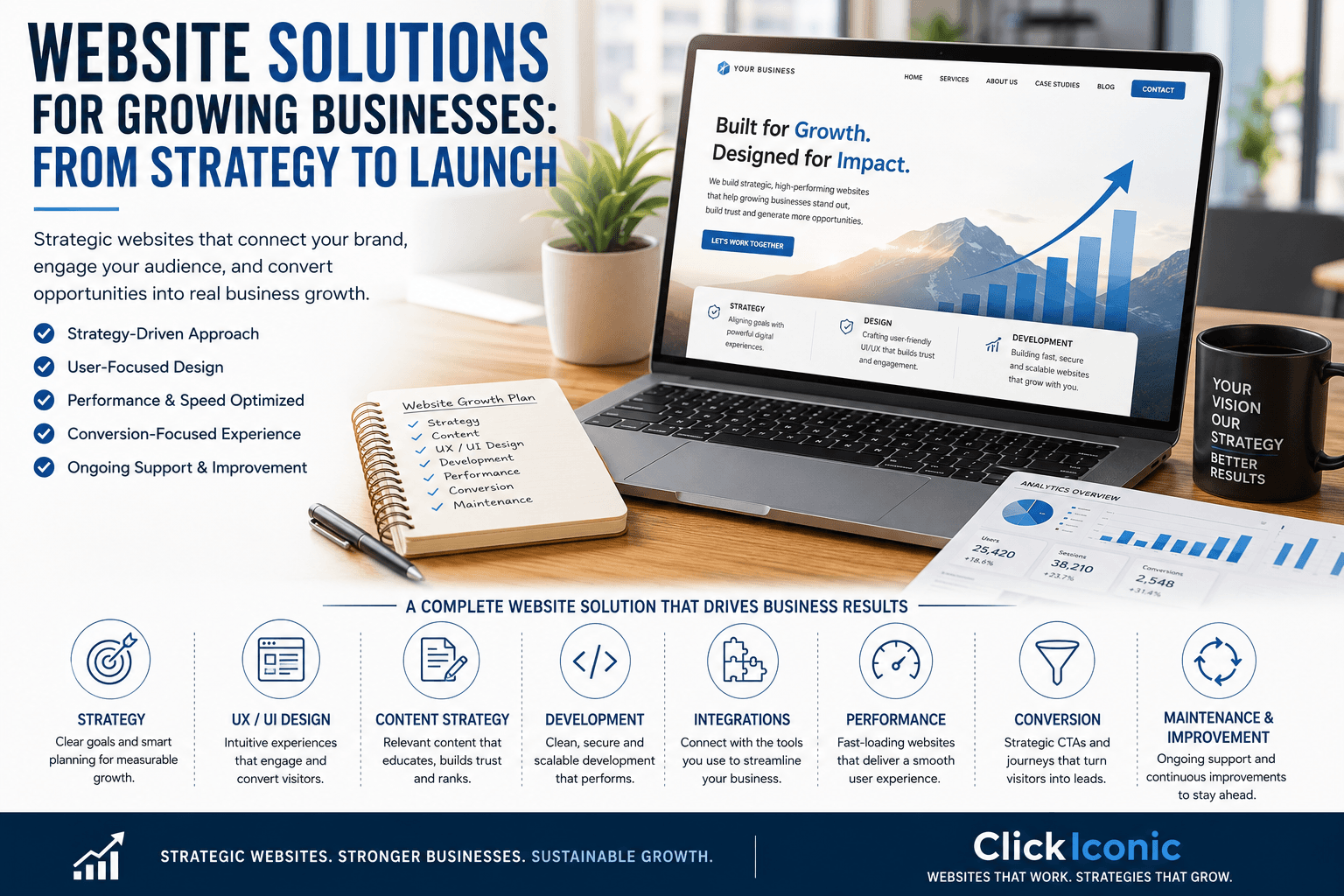
The strongest website solutions do not treat strategy, design, development, content, performance, and maintenance as separate activities. They connect them into one digital system.
A website audit can reveal what is currently holding the experience back. Strategy can define what the website needs to accomplish. UX/UI can make the experience easier to use. Content structure can make information easier to understand. Development can turn the plan into a reliable website.
Integrations can connect the website to the wider business. Performance can make the experience faster and more professional. Conversion work can help visitors move from interest to meaningful action. Maintenance can protect the investment after launch.
But none of those stages should exist in isolation.
A business changes. Customers change. Services change. Search behaviour changes. Technology changes. The website therefore needs enough structure to remain useful without becoming difficult to evolve.
This is why the right website solution is not always a complete redesign. It may be better content. It may be better UX. It may be better performance. It may be a technical improvement. It may be stronger conversion paths. Or it may be a new website because the existing foundation can no longer support what the business needs.
The important thing is to understand the problem before deciding on the project.
- ✓Start with a website audit
- ✓Define the business and customer strategy
- ✓Build a clear information architecture
- ✓Create a useful content structure
- ✓Design around user experience
- ✓Develop a reliable technical foundation
- ✓Connect relevant business tools
- ✓Optimise performance
- ✓Create clear conversion paths
- ✓Maintain the website
- ✓Measure real behaviour
- ✓Continuously improve the experience
See how ClickIconic approaches professional digital experiences for trust-based service businesses: /approach
Explore The ClickIconic Difference and how we approach business website solutions.
See relevant projects and examples through our success stories: /success-stories
Explore more practical guidance about websites, credibility, and digital presence: /insights
If you are considering improving your website, discuss your current website and business goals with ClickIconic: /contact
The goal of effective website solutions is simple: make the business easier to understand, easier to trust, easier to explore, and easier to choose—today and as the business grows.
Website Solutions Checklist
Does Your Website Support Your Business?
- ✓Visitors immediately understand what your business does
- ✓Your ideal customers can recognise that your offer is relevant to them
- ✓Your website reflects the current stage of your business
- ✓Your main services are easy to discover
- ✓The homepage communicates a clear value proposition
- ✓Navigation is logical
- ✓Content is structured around customer needs
- ✓Service pages clearly explain your value
- ✓Trust signals are easy to find
- ✓Your website works well on mobile
- ✓Pages load quickly
- ✓Forms are easy to complete
- ✓Calls-to-action are clear
- ✓Your website supports meaningful conversion
- ✓Important integrations work correctly
- ✓Analytics and tracking are in place
- ✓The website is regularly maintained
- ✓Content is updated when the business changes
- ✓Performance is monitored
- ✓There is a process for continuous website improvement
When Should You Consider Improving Your Website?
- ✓Your business has changed but the website has not
- ✓Visitors struggle to understand what you offer
- ✓Your strongest services are difficult to find
- ✓Your website content is difficult to scan
- ✓The customer journey is unclear
- ✓Your website looks good but does not generate enough enquiries
- ✓The mobile experience is frustrating
- ✓Pages load slowly
- ✓Important trust signals are missing
- ✓Forms are unnecessarily complicated
- ✓Your website lacks useful integrations
- ✓Your current technology limits future improvements
- ✓Your website is difficult to maintain
- ✓You are adding pages without a clear structure
- ✓The website does not reflect the quality of the business
- ✓You are making changes without knowing whether they improve results
Frequently Asked Questions
Key Takeaways
- ✓Website solutions should solve business problems rather than simply produce attractive pages.
- ✓A website audit can identify problems before unnecessary redesign or development work begins.
- ✓Website strategy should connect business objectives with customer needs and conversion goals.
- ✓Website UX design and website UI design should work together to make the experience easier to understand and use.
- ✓Website content strategy should reflect the customer journey rather than simply the internal structure of the business.
- ✓Website development should create a reliable, scalable, accessible, and maintainable technical foundation.
- ✓Website integrations should improve business processes or the customer experience rather than add unnecessary complexity.
- ✓Website performance optimization is part of usability, credibility, and conversion.
- ✓Website conversion optimization should make the right next step easier rather than forcing visitors to act.
- ✓Website maintenance services protect both the technical foundation and the relevance of the website.
- ✓Long-term website improvement allows the digital experience to evolve with real customer behaviour and business growth.
- ✓Website consulting can help identify the right solution before a business commits to a large project.
- ✓The right website solution is not always a complete redesign. It is the solution that addresses the actual problem.
Does Your Website Actually Support the Way Your Business Is Growing?
Your business may already have strong services, valuable expertise, satisfied customers, and a clear direction. The question is whether your website communicates those strengths clearly enough and supports the customer journey effectively.
Discuss Your Website