
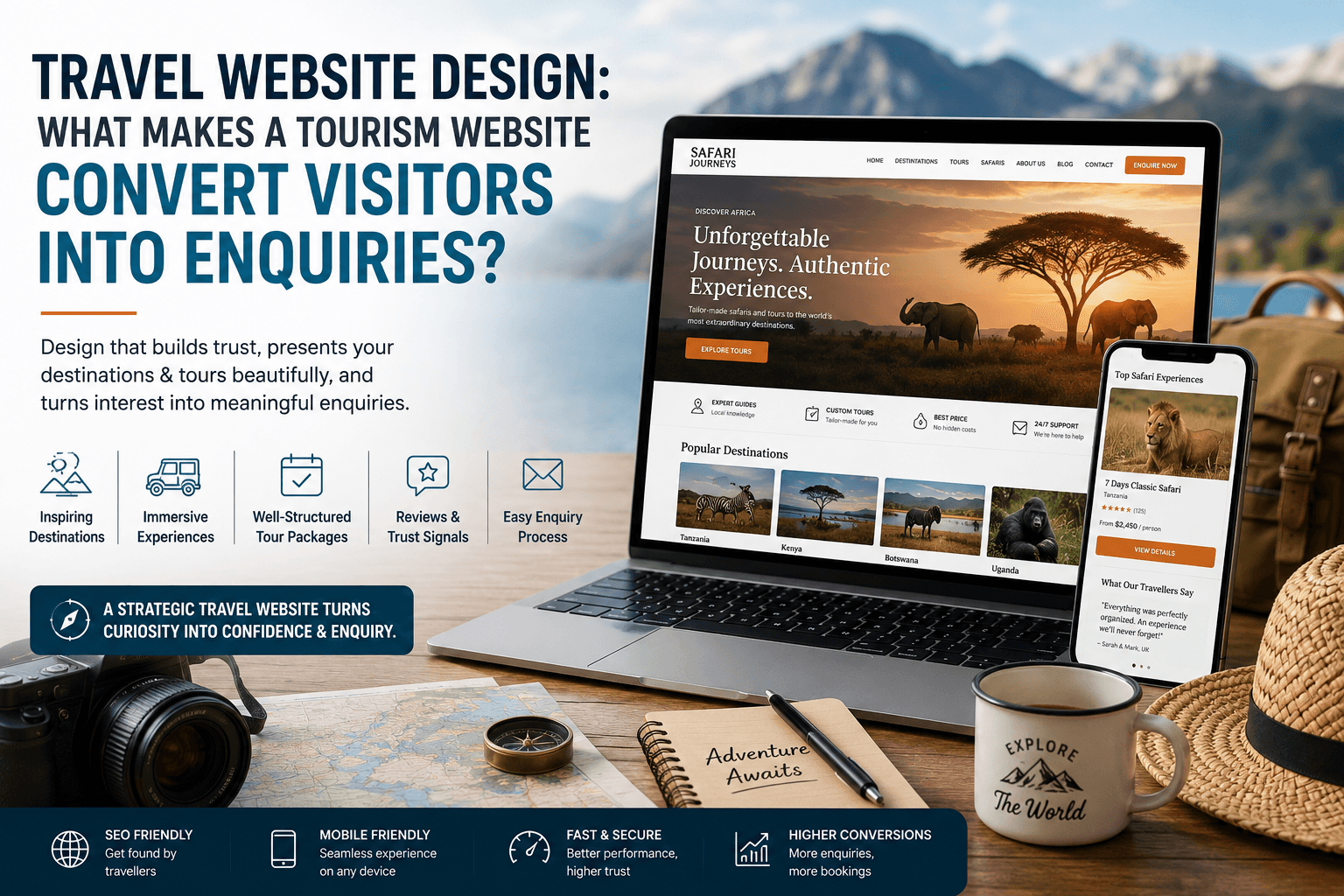
Imagine someone has just discovered a destination they want to visit. They search for tours, safari experiences, photography trips, or travel packages and begin opening several websites in different tabs.
At this point, the travel company has not spoken to the visitor. There has been no sales call, no WhatsApp conversation, and no personal recommendation. The website is doing the first part of the sales conversation on its own.
The visitor is looking at photographs, destinations, tour packages, reviews, itineraries, prices, company information, and contact options. More importantly, they are trying to decide whether this travel business understands what they are looking for and whether they can trust it with an important part of their journey.
This is where effective travel website design becomes important. A tourism website should not simply look attractive. It should make the destination desirable, the experience understandable, the company credible, and the next step easy.
A beautiful website can attract attention, but attention alone does not create an enquiry. The visitor needs enough information and evidence to move from curiosity to confidence.
The strongest travel websites therefore create a connected journey. The homepage introduces the travel business. Destinations create interest. Tour packages provide options. Photography helps visitors imagine the experience. Reviews reduce uncertainty. Clear calls-to-action make it easier to enquire or book.
This becomes even more important for international travellers. Someone planning a trip from another country may have additional questions about safety, logistics, communication, accommodation, transfers, payment, itinerary details, and the credibility of the company they are considering.
Effective travel website design brings these questions into the customer journey instead of expecting visitors to search for answers elsewhere.
The goal is not to pressure every visitor into booking immediately. The goal is to help the right visitor understand the experience, trust the operator, and feel confident enough to take the next step.
Trust Begins Before the Traveller Makes an Enquiry
For many travel businesses, the first sales conversation happens without a salesperson present. A traveller finds the company through Google, social media, a recommendation, or a destination search, then opens the website and starts deciding whether the business is worth contacting.
They are not usually judging the site by design terminology. They are looking for answers: Does this company understand the destination? Are these tours relevant to me? Do the photographs look real? Can I trust the people behind the business? What happens if I have a question?
That makes travel website design a commercial decision, not just a visual one. The website has to remove enough uncertainty for a visitor to continue exploring.
This matters even more for international travellers. When someone is planning a trip from another country, the website may be the main evidence they have about the operator before they make contact.
A useful rule is simple: do not make the traveller work to discover the reasons they should trust you. Show the destination expertise, real experiences, customer proof, practical information, and next step where they naturally need them.
- ✓The business is clear within the first few seconds
- ✓Destinations and experiences are easy to discover
- ✓The photography feels authentic
- ✓Tour information answers practical questions
- ✓Reviews and credibility signals are visible
- ✓International travellers can find essential information
- ✓The enquiry path is obvious
Trust starts when the traveller first encounters the business online. The website should earn that trust before asking for an enquiry.
Build a Travel Website Homepage That Creates Immediate Clarity
A travel website homepage has a difficult job: create desire without creating confusion. A beautiful hero image is useful, but it cannot explain the business by itself.
A visitor should quickly understand what you offer, where you operate, who the experience is for, and what they can do next. A vague headline such as Discover Africa may look polished but leaves too many commercial questions unanswered.
A stronger travel website homepage combines a clear value proposition with destination-led imagery, featured experiences, proof, and a relevant call-to-action. The exact order can change by business type, but every section should earn its place.
For example, a safari operator may lead with a signature safari experience, while a luxury travel company may lead with a highly personalised planning proposition. A photography tour company may need to make specialist expertise visible much earlier.
The homepage should not try to contain the whole business. Its job is to help the right visitor recognise themselves, understand the offer, and choose the most useful next step.
The strongest travel website homepage answers the visitor's first questions quickly and gives them a natural reason to continue.
Present Destinations So Visitors Can Imagine the Journey
A destination page should do more than tell travellers where you operate. It should help them picture what being there could actually feel like.
Effective destination website design combines visual storytelling with useful information. Depending on the destination, that may include landscapes, wildlife, culture, activities, seasons, highlights, travel style, and practical considerations.
The commercial connection matters too. If someone is researching Tanzania, they should be able to move naturally from the destination to relevant safari experiences, photography tours, or itineraries. They should not have to start their search again from the main menu.
Useful destination content also captures earlier-stage search intent. Someone who is still deciding when to visit or how long to stay may not be ready to enquire today, but a helpful page can keep the business in consideration.
Think of the destination page as the bridge between inspiration and a specific experience.
- ✓Introduce the destination clearly
- ✓Explain what makes it worth visiting
- ✓Use authentic destination photography
- ✓Highlight key experiences
- ✓Explain relevant seasons
- ✓Cover wildlife, culture, landscapes, or activities where relevant
- ✓Connect destinations to relevant tour packages
- ✓Answer common traveller questions
- ✓Provide a clear next step
A destination page works when the traveller leaves with a clearer picture of the place and a clearer idea of what they could do there.
Present Tour Packages Around the Traveller's Needs
A traveller comparing tours is not simply looking for a name and a price. They are trying to work out whether the experience fits their time, interests, expectations, and budget.
A tour package website should make that decision easier. Duration, itinerary, destinations, activities, accommodation, transportation, inclusions, exclusions, pricing, and practical information should be organised so the important details are easy to scan.
The page also needs to answer the question that competitors often leave unclear: why this experience? A strong package presentation explains who it suits, what makes the itinerary different, and what the traveller can realistically expect.
Do not hide the useful detail behind clever design. Clear structure usually builds more confidence than excessive animation.
The enquiry should feel like the natural next step. Someone who wants different dates, a private departure, a group arrangement, or a custom itinerary should immediately know how to ask.
- ✓Tour name and clear positioning
- ✓Destination or destinations included
- ✓Duration
- ✓Structured itinerary
- ✓Key experiences
- ✓Accommodation information where relevant
- ✓Transportation information
- ✓Inclusions and exclusions
- ✓Best-suited traveller type
- ✓Pricing or starting price where appropriate
- ✓Relevant photographs
- ✓Customer reviews where available
- ✓Clear enquiry or booking CTA
The best package page does not merely list what is included. It helps the traveller decide whether the experience is right for them.
Show Safari and Tour Experiences Instead of Just Listing Tours
For safari operators and specialist travel companies, the experience is often the product. A list of destinations and prices cannot communicate everything that makes the journey valuable.
A safari may involve wildlife viewing, specialist guiding, photography, landscapes, conservation, local culture, private vehicles, or a particular style of travel. Those details are what differentiate one operator from another.
A good safari website design approach brings those details forward. Show what a typical day might feel like, what the guide contributes, what the traveller may see, and which kind of guest the experience suits.
The same principle applies to photography tours, adventure travel, and luxury journeys. Expertise becomes easier to trust when visitors can see it in the experience itself.
This is also where real stories and real photographs become valuable. They demonstrate that the company is not simply selling an idea of travel; it has actually delivered the experience.
The clearer the experience becomes, the easier it is for a traveller to understand the value behind the tour.
Use Photography to Create Desire Without Losing Authenticity
Travel photography is often the first thing people notice. It can make a destination feel close enough to imagine, but it can also create the wrong expectation if every image is generic or disconnected from the actual operator.
Use photography to show the real experience: landscapes, wildlife, guides, vehicles, accommodation, people, activities, and the small details that make the journey distinctive.
Real photographs from previous tours can do more than fill a gallery. They can demonstrate capability and give visitors evidence of what the company actually delivers.
Images should also support the surrounding content. A photograph of a safari vehicle becomes more useful when the page explains the type of safari, the guide, the route, or the experience associated with it.
Performance matters as well. Large, unoptimised photographs can slow down pages, particularly on mobile devices. The visual experience should feel premium without becoming a performance problem.
Great travel photography should make the journey desirable while keeping expectations grounded in the real experience.
Use Reviews and Trust Signals to Reduce Uncertainty
A traveller can love the destination and still hesitate over the operator. Reviews and other proof help answer the question that beautiful design cannot: has someone else trusted this company before?
Tourism website credibility becomes stronger when proof is specific. A detailed traveller experience is more persuasive than a generic line such as Excellent service.
Useful trust signals can include years of experience, destination expertise, specialist guides, professional memberships, local presence, awards where relevant, media coverage, real tour photographs, and clear company information.
Do not isolate all proof on a single testimonials page. Put relevant evidence close to the decision it supports. A tour page can show a related review. A destination page can include guest experiences. A safari page can show photographs from previous trips.
The point is not to decorate the website with badges. It is to answer uncertainty at the moment it appears.
Traveller Reviews
Specific customer experiences help potential travellers understand what it is actually like to work with the operator.
- ✓Specific traveller experiences
- ✓Real customer names where appropriate
- ✓Destination or tour context
- ✓Relevant outcomes or highlights
- ✓Links to trusted review platforms where appropriate
Experience and Expertise
Relevant experience helps visitors understand the knowledge behind the travel business.
- ✓Years of operation
- ✓Destination expertise
- ✓Specialist guides
- ✓Local knowledge
- ✓Photography or safari expertise
- ✓Relevant industry experience
Previous Travel Experiences
Real examples can demonstrate that the company actively delivers the experiences it promotes.
- ✓Previous tour photographs
- ✓Safari experiences
- ✓Guest stories
- ✓Destination examples
- ✓Case studies where relevant
Professional Business Information
Clear business information can reduce uncertainty for travellers researching an unfamiliar operator.
- ✓Business name
- ✓Professional contact information
- ✓Company details
- ✓Location information
- ✓Clear communication channels
Strong travel websites do not repeatedly claim that they are trustworthy. They give visitors enough evidence to reach that conclusion themselves.
Create a Clear Enquiry and Booking Journey
A traveller may be ready to talk but still leave if the contact process feels like work. For many travel businesses, the first enquiry is where the website finally hands the conversation to the team.
Travel enquiries can involve dates, group size, destination, accommodation, activities, budget, dietary requirements, transfers, or custom arrangements. The first form does not need to collect everything.
Ask for the information that helps start a useful conversation: name, email, travel dates, destination, number of travellers, preferred experience, and a message. More detail can be collected later.
Just as important, tell the visitor what happens next. If someone will respond within a particular period, say so. If the team will suggest an itinerary or discuss a customised trip, make that clear.
For specialist safari, photography, luxury, or customised travel companies, consultation-led enquiry can be more appropriate than forcing immediate online booking. The CTA should reflect the real buying process.
The first conversion is often not a booking. It is a useful conversation. Make starting that conversation easy.
Design the Website Around Travel Website Conversion
Travel website conversion should not be measured only by completed bookings. For a high-consideration travel business, a qualified enquiry, quote request, availability question, or itinerary discussion can be a valuable conversion.
Visitors arrive with different levels of intent. One may be dreaming about a destination. Another may be comparing safari packages. A third may already know the dates and simply want to check availability.
The website should respect those differences. Early-stage visitors may need Explore Destinations. Someone researching experiences may need View Safari Experiences. A visitor who has read a specific package may be ready for Enquire About This Tour.
This is where travel website design becomes more strategic. Instead of putting the same aggressive sales CTA everywhere, build a path that matches the visitor's confidence.
The practical question is: what uncertainty is stopping this visitor from taking the next step? Better content, proof, navigation, or a clearer CTA may solve that problem.
Good travel website conversion does not push the traveller harder. It removes the reasons they might hesitate.
Create a Mobile-Friendly Travel Website
A traveller may discover a destination on a phone, compare tours on a tablet, and send an enquiry from a laptop. The experience should remain coherent across all three.
A mobile-friendly travel website needs more than a responsive layout. Large photography, detailed itineraries, galleries, maps, menus, forms, and CTAs all need to remain usable on smaller screens.
Check whether visitors can actually read tour details, open destinations, view photographs, find reviews, and start an enquiry without pinching, hunting, or waiting.
Performance is part of the experience. Heavy imagery and unnecessary effects can make a premium website feel slow. That can damage both usability and the professional impression of the business.
A Mobile Travel Website Should Provide
Every important part of the research and enquiry journey should remain clear and usable regardless of the device.
- ✓Responsive layouts
- ✓Readable typography
- ✓Optimised travel photography
- ✓Fast-loading pages
- ✓Simple navigation
- ✓Easy-to-use enquiry forms
- ✓Clear destination navigation
- ✓Accessible tour information
- ✓Easy-to-tap CTAs
- ✓Consistent experience across devices
Common Mobile Travel Website Problems
- ✓Slow-loading destination images
- ✓Text that is difficult to read
- ✓Menus that are difficult to use
- ✓Buttons that are too small
- ✓Tour itineraries that are difficult to scan
- ✓Forms that are frustrating to complete
- ✓Important information hidden too deeply
- ✓Large galleries that slow down the page
- ✓Pop-ups that interrupt travel research
- ✓CTAs that are difficult to find
Design for International Travellers
When a traveller is booking from another country, distance creates another layer of uncertainty. Your website needs to make the business feel understandable before the first conversation begins.
Visitors may want to know where the company is based, how communication works, what payment options are available, how transfers and accommodation are handled, what safety information is relevant, and what happens during the trip.
That does not mean putting every answer on the homepage. Organise the information so it is easy to find when the question occurs.
Professional company information also matters. Clear ownership or company details, a professional email address, practical contact options, transparent tour information, and realistic response expectations can make an unfamiliar operator feel much more credible.
Use clear international English when the audience spans countries, and provide currency information where it genuinely helps.
For international travellers, clarity is a trust signal. The easier it is to understand the operator and the journey, the easier it becomes to start a conversation.
Build a Foundation for Travel Website SEO
A beautiful website cannot create enquiries from people who never find it. Travel website SEO should therefore be built into the information structure from the beginning, not added as an afterthought.
Travel businesses can target search intent around destinations, activities, safari experiences, photography tours, tour packages, and practical travel questions. That makes page structure particularly important.
Give important destinations their own useful pages. Give important tours their own pages. Make specialist experiences clear. Use descriptive titles, headings, relevant content, image alt text, logical URLs, and internal links.
Internal linking also supports the traveller journey. A destination page can lead to relevant tours; a tour can lead back to the destination; a useful insight can connect both.
Avoid creating thin pages simply because a keyword exists. Search visibility is more useful when the content genuinely helps a traveller make a decision.
Travel website SEO works best when search visibility and visitor usefulness are designed as one system.
Improve the Travel Website User Experience
Travel websites can contain dozens of destinations, tours, experiences, galleries, stories, and practical pages. Without a clear structure, even good content becomes difficult to use.
A visitor may start with a destination, move to experiences, compare tours, read reviews, and then enquire. Navigation should support that behaviour instead of forcing the visitor back to the beginning.
A destination page should connect to relevant tours. A tour page should make related destinations and experiences easy to discover. Long itineraries should be broken into scannable sections rather than presented as walls of text.
Good travel website user experience is not about removing useful information. It is about reducing the effort required to understand it.
The best UX lets travellers explore freely while keeping the next useful piece of information close at hand.
When Does a Travel Website Need a Redesign?
A travel website redesign is not automatically necessary because a website looks old. The stronger reason is a gap between the quality of the business and what the website communicates.
Maybe your destinations have expanded. Perhaps your photography is now much stronger, your tours have become more specialised, or you are targeting more international travellers. If the website still reflects an older version of the business, potential customers may never see the improvement.
A website can also look acceptable and still perform poorly. If visitors struggle to find destinations, understand packages, trust the operator, use the site on mobile, or start an enquiry, the problem is strategic rather than cosmetic.
A redesign should therefore improve the traveller journey, not simply replace the colours, fonts, and hero image.
A Travel Website Redesign Should Improve More Than Appearance
A strategic redesign should make destinations easier to understand, experiences easier to explore, credibility easier to recognise, and enquiries easier to start.
- ✓Clearer travel business positioning
- ✓Stronger homepage structure
- ✓Better destination presentation
- ✓Improved tour package structure
- ✓Stronger experience presentation
- ✓More effective photography
- ✓Better reviews and trust signals
- ✓Improved mobile experience
- ✓Clearer navigation
- ✓Stronger travel website conversion
- ✓Simpler enquiry journey
- ✓Better SEO structure
The purpose of a redesign is not to make the website newer. It is to make the business easier to understand, trust, explore, and contact.
Travel Website Self-Assessment
Before deciding that you need a completely new website, look at your current one as if you were a traveller who had never heard of your company before.
Do not ask whether you personally like the design. Ask whether a first-time visitor can understand the offer, find the right destination, trust the operator, explore a suitable experience, and contact the business without unnecessary effort.
Give yourself one point for every 'yes'. If several answers are uncertain or difficult to verify, there may be a bigger opportunity than a visual refresh.
The point of this assessment is not to sell you a redesign you do not need. It is to show where the current website may be losing confidence before the conversation even begins.
Build a Travel Website That Makes the Next Step Easier
A high-performing travel website connects inspiration with evidence, useful information with action, and the quality of the travel business with the quality of its online experience.
The important thing is how these parts work together. A beautiful photograph may create interest, but the destination page has to explain the experience. A tour package may create intent, but the visitor still needs proof. A review can build confidence, but the enquiry process has to make sense.
That is why travel website design should be treated as a complete customer journey rather than a collection of attractive pages.
At ClickIconic, we approach travel websites from the traveller's side of the conversation. Before asking what should be added to the website, we ask what a potential customer needs to understand before feeling comfortable enough to enquire.
That means looking at the business positioning, destinations, experiences, photography, credibility, mobile journey, SEO structure, navigation, and enquiry flow together. If the tours are excellent but the website makes that difficult to see, the website is not doing the business justice.
For a travel business considering a new website or redesign, the objective should therefore be bigger than a modern visual appearance. The website should make the right destination easier to discover, the experience easier to imagine, the operator easier to trust, and the next step easier to take.
If your website already attracts visitors but does not generate enough meaningful enquiries, do not immediately assume that you need more traffic. First ask whether the website is doing enough to turn interest into confidence.
That is the point where a focused website review can be valuable.
- ✓Clear travel business positioning
- ✓Strong travel website homepage
- ✓Useful destination presentation
- ✓Well-structured tour packages
- ✓Experience-focused safari and tour content
- ✓Authentic travel photography
- ✓Traveller reviews and trust signals
- ✓Clear enquiry and booking journey
- ✓Strong travel website conversion strategy
- ✓Mobile-friendly experience
- ✓International traveller information
- ✓Solid travel website SEO foundation
- ✓Simple travel website user experience
- ✓Fast and reliable performance
See how ClickIconic approaches professional digital experiences for trust-based service businesses: /approach
Explore the Travel & Tourism Website Design section on the ClickIconic homepage.
See relevant travel projects and examples through our success stories: /success-stories
Explore more practical guidance about websites, credibility, and digital presence: /insights
If you are considering improving your travel website, discuss your business and current website with ClickIconic: /contact
The goal of effective travel website design is simple: make the destination compelling, the experience understandable, the business credible, and the next step easy.
Travel Website Conversion Checklist
Does Your Travel Website Build Traveller Confidence?
- ✓Visitors immediately understand what type of travel business you are
- ✓Your key destinations are easy to discover
- ✓The travel website homepage communicates a clear value proposition
- ✓Your ideal travellers can recognise that your tours are relevant to them
- ✓Tour packages are easy to understand
- ✓Destination pages provide useful information
- ✓Safari and tour experiences are clearly presented
- ✓Your photography represents the actual travel experience
- ✓Traveller testimonials are visible
- ✓Relevant tourism website credibility signals are displayed
- ✓Your company information is easy to find
- ✓International travellers can find important practical information
- ✓Your contact information is easy to access
- ✓The travel website enquiry process is simple
- ✓Clear calls-to-action guide visitors towards the next step
- ✓The website works well on mobile devices
- ✓Pages load quickly enough to provide a smooth experience
- ✓Your website supports basic travel website SEO
- ✓Related destinations and tours are internally linked
- ✓The website generates meaningful enquiries
When Should You Consider a Travel Website Redesign?
- ✓Your website looks outdated compared with the quality of your tours
- ✓Visitors cannot quickly understand what your company offers
- ✓Your strongest destinations are difficult to find
- ✓Tour packages are difficult to compare or understand
- ✓Your travel experiences are not presented clearly
- ✓Your best photography is not being used effectively
- ✓Reviews and trust signals are difficult to find
- ✓International travellers cannot easily find useful information
- ✓The mobile experience feels slow or difficult to use
- ✓Visitors need to search too hard for important information
- ✓Your website generates traffic but very few meaningful enquiries
- ✓Your business has evolved but the website has not kept up
- ✓The website looks good but does not guide visitors towards an enquiry
- ✓The website does not create the level of confidence your travel business deserves
Frequently Asked Questions
Key Takeaways
- ✓A travel website should turn destination interest into confidence and meaningful action.
- ✓The homepage should make the business, destination focus, audience, and next step clear.
- ✓Destination and tour pages should help visitors imagine the actual experience and understand its value.
- ✓Authentic photography, reviews, expertise, and practical information can reduce uncertainty.
- ✓The enquiry journey should match how travellers actually make decisions rather than forcing immediate booking.
- ✓Mobile usability, performance, navigation, and travel website SEO are part of the customer experience.
- ✓A redesign should improve communication, credibility, usability, and conversion—not simply visual appearance.
- ✓The strongest travel websites make the destination compelling, the experience understandable, the business credible, and the next step easy.
Does Your Travel Website Turn Interest Into Enough Enquiries?
Your travel business may already have exceptional destinations, memorable experiences, specialist knowledge, strong photography, and satisfied travellers. The real question is whether your website communicates those strengths clearly enough for a first-time visitor to understand, trust, and act.
Discuss Your Travel Website