
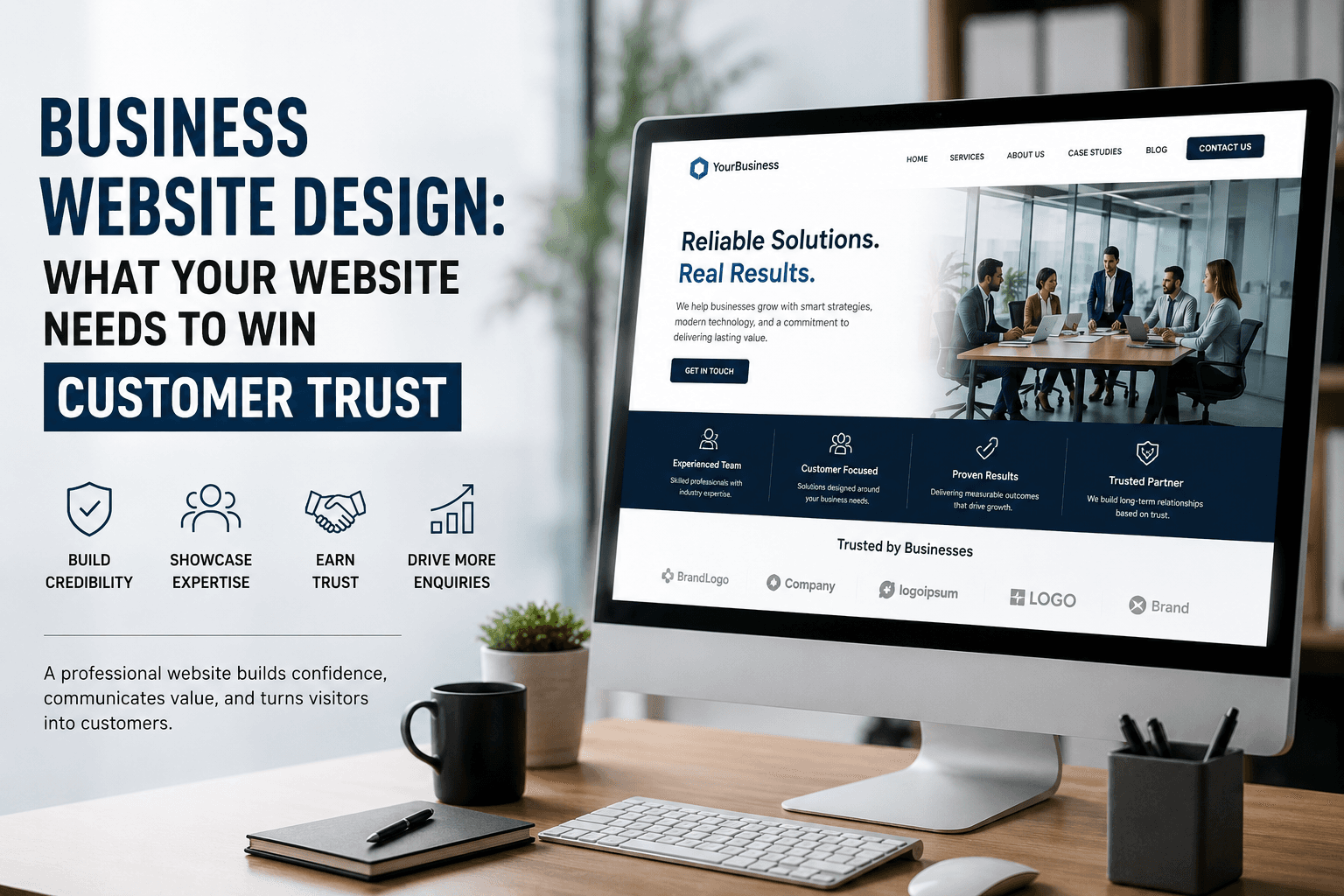
Imagine a potential customer has just heard about your business. Before calling, emailing, requesting a quotation, or booking a consultation, they visit your website to decide whether your company is worth contacting.
Within a few moments, they may look at your homepage, services, About page, testimonials, photographs, contact information, and overall presentation. They are not simply looking at how attractive the website is. They are trying to understand the business behind it.
The question they are asking is simple: Can I trust this business?
You may have years of experience, strong expertise, excellent services, successful projects, and satisfied customers. But if those strengths are difficult to see online, potential customers may never recognise the value that already exists inside your business.
This is where effective business website design becomes important. A professional website should do more than present information or make a business look modern. It should organise information around the questions customers are already asking, make credibility easier to recognise, and create a natural path towards an enquiry.
Think of your website as part of the conversation that happens before you ever speak to the customer. The homepage creates the first impression. Service pages explain your value. The About page makes the business more recognisable. Testimonials and trust signals provide evidence. The contact journey makes taking action easier.
If your business is strong but your website feels outdated, unclear, difficult to navigate, or disconnected from the quality of your services, the problem may not be your business. It may be the way your business is being presented online.
That distinction matters. A website redesign should not simply make an old website look newer. It should help the right customers understand your business faster, trust it more confidently, and know what to do next.
Trust Begins Before the First Enquiry
For many customers, the first interaction with a business happens through its website long before anyone from the company receives an enquiry.
Potential customers often compare several businesses before deciding who to contact. They may search online, visit different websites, compare services, read testimonials, look at company information, and try to understand which business appears most suitable.
This means your website is already participating in the sales conversation before a member of your team speaks with the customer.
Visitors are silently asking questions about whether your business is legitimate, whether you understand their needs, whether you have enough experience, whether your service is relevant, and whether they can trust you.
They may also be asking something more subtle: does this website feel like it belongs to a business capable of delivering the quality I am looking for?
If the website answers these questions clearly, confidence starts to develop. If the website creates confusion or uncertainty, visitors may simply leave and continue their search elsewhere.
This is why business website design should be treated as more than a visual exercise. The layout, content, navigation, images, trust signals, and calls-to-action all contribute to how customers perceive the business.
A strong website does not force the visitor to trust the business. It gives them enough relevant information and evidence to make that trust easier.
The objective is not to turn every visitor into an immediate customer. It is to make the right visitor feel confident enough to continue exploring and eventually take the next step.
- ✓Does this business appear legitimate?
- ✓Do they understand what I need?
- ✓Do they have relevant experience?
- ✓Can I trust the quality of their service?
- ✓Have other customers worked with them?
- ✓Is there enough information to make a decision?
- ✓Does the website reflect the quality of the actual business?
- ✓Can I easily contact them if I have questions?
Customer trust does not begin when someone submits an enquiry. It begins when the visitor first encounters your business online.
Is Your Website Helping Your Business or Making Customers Hesitate?
A business website can look perfectly acceptable to its owner while still creating uncertainty for someone visiting it for the first time.
Business owners usually know their company extremely well. They already understand the services, experience, people, achievements, and value behind the business. Because of that familiarity, it can be difficult to notice what a new visitor does not understand.
A potential customer does not have that background knowledge. They arrive without context and quickly try to answer basic questions: What does this company actually do? Is it relevant to me? Can I trust them? Have they done this before? What happens if I contact them?
If the website makes those answers difficult to find, the visitor has to work too hard. They may not complain about the website. They may simply leave and continue comparing other businesses.
This is especially important when the business itself is strong. A company can have excellent expertise and satisfied customers but still lose opportunities if its website communicates those strengths poorly.
Before changing colours, fonts, animations, or layouts, look at the website from the perspective of someone who knows nothing about the business. The problem may be less about visual appearance and more about clarity, trust, structure, and the path towards an enquiry.
If several of these questions are difficult to answer from your current website, the issue may not be your business. It may be the way your business is being communicated online.
The Essential Elements of Effective Business Website Design
A professional business website does not need to contain every possible feature. It needs the right elements arranged around the questions customers are trying to answer.
The most effective business website design focuses on clarity before complexity. Visitors should be able to understand the business, its services, its credibility, and the next step without having to work too hard.
Although every business is different, several core elements consistently contribute to a stronger digital presence.
These include a clear homepage, well-structured service pages, a credible About page, relevant trust signals, testimonials, simple contact options, strong calls-to-action, mobile responsiveness, and good performance.
The important part is not simply having these pages. Each element needs to perform a specific role in the customer journey.
A homepage should create clarity. Service pages should explain value. The About page should build familiarity. Testimonials should provide evidence. Contact pages should make action easy.
When these elements work together, the website becomes a connected credibility system rather than a collection of separate pages.
That is the difference between having a website and having a professional business website that actively supports the customer journey.
- ✓Clear homepage messaging
- ✓Logical website structure
- ✓Well-presented service pages
- ✓Useful About page
- ✓Relevant trust signals
- ✓Customer testimonials
- ✓Simple contact and enquiry system
- ✓Clear calls-to-action
- ✓Mobile-friendly experience
- ✓Fast and reliable performance
Good business website design is not about adding more elements. It is about making every important element contribute to clarity, credibility, or conversion.
Build a Homepage That Answers the Right Questions
The homepage is often the first page a potential customer sees, so it needs to establish relevance and trust quickly.
A strong homepage should help visitors understand who you are, what you offer, who you help, and why your business is worth considering.
One common mistake is trying to put every piece of information on the homepage. This can create a long page without a clear journey.
Instead, the homepage should guide visitors through the most important questions in a logical order.
The hero section should establish the core value proposition. The next sections can introduce key services, demonstrate credibility, show selected work or results, explain the approach, present testimonials, and provide a clear next step.
The exact structure will vary depending on the business, but the principle remains the same: the homepage should reduce uncertainty and help visitors understand what to do next.
A visually impressive homepage that does not communicate the business clearly is less effective than a simpler homepage that immediately answers the customer's most important questions.
The homepage should therefore be designed around customer decisions rather than simply around the sections the business wants to display.
The best homepage structure is not the one with the most sections. It is the one that creates the clearest path from first impression to confidence.
Present Your Services Around Customer Needs
Service presentation is one of the most important parts of a business website because customers need to understand exactly how your business can help them.
Simply listing services is rarely enough. Visitors need context around what each service does, who it is for, what problem it addresses, and what value it provides.
A service page should help the customer decide whether the offering is relevant to their situation.
For example, instead of presenting a service with only a name and a short description, explain the problem it addresses, what is included, how the process works, and what the customer can expect.
This approach also makes the business appear more knowledgeable because the website demonstrates an understanding of customer needs rather than simply promoting a list of capabilities.
For businesses with several services, clear categorisation and navigation become especially important. Visitors should not have to search through unrelated information to find what they need.
The goal is to make service information easy to understand while creating enough confidence for the visitor to ask questions or start an enquiry.
A strong service page should make the customer think: This business understands the problem I have and appears capable of helping me solve it.
- ✓Clearly name each service
- ✓Explain who the service is for
- ✓Describe the problem or need it addresses
- ✓Explain what is included
- ✓Highlight relevant benefits
- ✓Show examples or related work where appropriate
- ✓Answer common customer questions
- ✓Provide a relevant call-to-action
Weak vs Strong Service Presentation
Common Approach: Website Design - We create professional websites for businesses.
- ✓Professional Website Design for Businesses
- ✓Websites designed to communicate your expertise, strengthen credibility, and make it easier for potential customers to understand and contact your business.
- ✓Clear positioning and messaging
- ✓Professional visual presentation
- ✓Mobile-friendly experience
- ✓Trust-focused content structure
- ✓Simple enquiry journey
Strong service presentation helps customers understand not only what you provide, but why that service matters to them.
Turn Your About Page Into a Trust-Building Asset
The About page is often underestimated, yet it can answer one of the most important customer questions: Who is behind this business?
Customers do not only want to know what a business sells. They often want to understand the people, experience, values, and background behind the business.
A generic About page filled with phrases such as committed to excellence or passionate about customer satisfaction does not provide much evidence.
A stronger About page explains the story of the business, introduces the people behind it, highlights relevant experience, and explains what influences the way the company works.
For a professional service business, this can be particularly important because customers are often choosing expertise rather than a physical product.
The About page should make the business feel real and credible. Real people, real experience, genuine photographs, relevant achievements, and a clear story can all contribute to this.
The purpose is not to write an autobiography. The purpose is to give customers enough context to understand why they can trust the people behind the service.
A good About page should also connect the company story back to customer value. Experience matters most when visitors can understand how that experience benefits them.
- ✓Explain how the business started
- ✓Introduce key people
- ✓Show relevant experience
- ✓Explain areas of expertise
- ✓Share the company's approach
- ✓Highlight meaningful achievements
- ✓Use genuine photographs
- ✓Connect the company story to customer value
A strong About page turns a business from an anonymous website into a more recognisable and credible organisation.
Use Trust Signals to Reduce Customer Uncertainty
Customers rarely trust a business because of one statement. Trust develops when several credible signals support the same impression.
A visitor may be interested in your services but still have concerns about reliability, experience, quality, legitimacy, or the outcome they can expect.
Relevant trust signals help answer these concerns before the visitor needs to ask.
The strongest trust signals are specific, authentic, and relevant. They demonstrate evidence instead of simply making claims.
Trust signals should also be distributed throughout the website rather than placed in one isolated section. A testimonial on the homepage, experience information on the About page, case studies on relevant service pages, and clear business information on the contact page can work together.
Consistency matters. If the visual presentation, messaging, customer proof, and company information all communicate the same level of professionalism, the overall website becomes more credible.
The purpose of trust signals is not to decorate the website with badges and claims. Their purpose is to reduce the uncertainty that can stop a potential customer from taking the next step.
Customer Testimonials
Testimonials show potential customers that other people have already trusted the business.
- ✓Authentic customer feedback
- ✓Specific experiences
- ✓Customer names or business names where appropriate
- ✓Relevant outcomes or benefits
Specific testimonials are more persuasive than generic statements because they provide evidence from people who have actually experienced the service.
Case Studies and Previous Work
Examples of previous work can demonstrate capability more effectively than broad claims.
- ✓Completed projects
- ✓Before-and-after examples
- ✓Client challenges
- ✓Solutions provided
- ✓Results or outcomes where available
Showing real work helps visitors understand what your business is capable of delivering.
Experience and Expertise
Relevant experience helps customers understand the depth of knowledge behind the business.
- ✓Years of experience
- ✓Specialist knowledge
- ✓Professional qualifications
- ✓Industry expertise
- ✓Relevant achievements
Experience becomes more credible when the website explains what that experience means for the customer.
Professional Business Information
Clear information about the business helps reduce uncertainty about who operates the website.
- ✓Business name
- ✓Clear contact information
- ✓Company information
- ✓Professional email address
- ✓Relevant location information
Transparency helps visitors feel more comfortable when deciding whether to start a conversation.
Testimonials Provide Evidence Behind Your Claims
Businesses often tell visitors that they are experienced, reliable, professional, or customer-focused. Testimonials provide an opportunity to demonstrate those claims through customer experiences.
A well-written testimonial can help a potential customer understand what it is actually like to work with the business.
The strongest testimonials are specific. Instead of simply saying excellent service, they explain what the customer needed, how the business helped, and what they appreciated about the experience.
Testimonials can also be placed strategically throughout the website. A general testimonial may work well on the homepage, while a service-specific testimonial can strengthen a particular service page.
If appropriate and with permission, adding customer names, company names, photographs, locations, or links to relevant profiles can make testimonials feel more authentic.
The objective is not to fill the website with praise. It is to provide credible evidence that supports the customer's decision-making process.
When testimonials are connected to specific services or customer problems, they become more than social proof. They become evidence that helps visitors imagine what working with the business could be like.
- ✓Use genuine customer feedback
- ✓Prefer specific experiences over generic praise
- ✓Connect testimonials to relevant services
- ✓Include identifying context where appropriate
- ✓Avoid editing testimonials so heavily that they lose authenticity
- ✓Keep testimonials easy to read
- ✓Use customer proof throughout the website rather than only on one page
A Strong Testimonial Should Help Answer
Potential customers should be able to understand why the previous customer chose the business and what they gained from the experience.
- ✓What problem did the customer have?
- ✓Why did they choose this business?
- ✓What was the experience like?
- ✓What did they value most?
- ✓What outcome or benefit did they receive?
Make Your Contact and Enquiry System Easy to Use
A visitor can trust your business and still leave if contacting you feels difficult or confusing.
The final step of the customer journey should not introduce unnecessary friction.
Many business websites use a generic Contact Us button but provide little information about what happens after the visitor clicks it.
For service-based businesses, customers may want to ask questions, explain their requirements, request a quotation, discuss a project, or determine whether the service is suitable for them.
The enquiry process should therefore make it easy for visitors to communicate their needs.
Forms should request the information genuinely needed to start the conversation. Asking for too many unnecessary details can discourage potential customers.
The surrounding copy should also provide reassurance. Explain what visitors can expect after submitting the form and, where appropriate, how quickly they can expect a response.
A simple enquiry journey can turn existing website interest into a real business opportunity.
The goal is not to force visitors to contact you. It is to remove the uncertainty and friction that can prevent an interested visitor from starting a conversation.
- ✓Use a clear contact or enquiry call-to-action
- ✓Keep forms focused on essential information
- ✓Explain what happens after submission
- ✓Provide alternative contact methods where appropriate
- ✓Make contact information easy to find
- ✓Avoid unnecessary form fields
- ✓Use service-specific enquiry options where useful
- ✓Provide a clear confirmation after submission
The purpose of an enquiry system is not to collect as much information as possible. It is to make the first conversation easy for the right customer.
Use Conversion-Focused Design Without Being Pushy
A conversion-focused website is designed to help visitors take meaningful next steps, but that does not mean every page needs aggressive sales messages.
For many professional businesses, customers do not make an immediate purchase. They may need to compare options, understand the service, review previous work, or speak with someone before making a decision.
This means the most valuable conversion may be an enquiry, consultation request, project discussion, or other meaningful interaction rather than an immediate transaction.
Conversion-focused design should therefore match the customer's level of intent.
Someone visiting a homepage for the first time may respond better to Learn More or Explore Our Services. A visitor who has already reviewed several service pages may be more ready for Discuss Your Project or Request a Consultation.
Calls-to-action should appear at logical points throughout the website and clearly communicate what happens next.
Good conversion-focused design removes uncertainty rather than creating pressure.
The strongest CTA is not necessarily the most aggressive one. It is the one that feels like the natural next step for the visitor at that moment.
The best conversion-focused business website design makes the next step feel natural, relevant, and low-friction.
How ClickIconic Thinks About Business Website Design
A website should not be designed simply because a business needs an online presence. It should be designed around what customers need to understand before they feel comfortable taking the next step.
At ClickIconic, we approach professional website design from the perspective of the visitor first. Before thinking about decoration, we consider what the customer needs to understand, what evidence they need to see, and what may prevent them from moving forward.
That means looking beyond colours, fonts, images, and animations. A strong professional business website needs clear positioning, logical structure, useful service information, credibility, usability, and a natural enquiry journey.
The homepage should answer the most important first questions. Service pages should make the business's value easier to understand. The About page should make the company more recognisable. Trust signals should support important claims. Calls-to-action should appear when the visitor is ready for them.
This approach is especially useful for trust-based service businesses where customers are often choosing expertise, reliability, experience, and confidence rather than simply purchasing a physical product.
The objective is not to make every website follow one visual formula. Different businesses need different structures, messages, and experiences. The objective is to make the website accurately represent the business while making its strengths easier for the right customers to recognise.
In other words, professional website design should connect business positioning with customer decision-making. The website should not merely say what the business does. It should help the visitor understand why the business is worth considering.
A professional website should work as a connected business experience, not simply as a collection of attractive pages.
Mobile Experience and Performance Affect Credibility
A website can have strong content and attractive design but still lose trust if it performs poorly on mobile devices.
Potential customers increasingly research businesses using smartphones and tablets. If the website is difficult to navigate, slow to load, or poorly formatted on smaller screens, the business can appear less professional.
Mobile usability is therefore not simply a technical requirement. It is part of the customer's perception of the business.
Visitors should be able to read important information, browse services, view testimonials, navigate between pages, and contact the business without struggling with the interface.
Performance also matters. Large images, unnecessary scripts, poor hosting configuration, and inefficient code can slow down the experience.
A professional business website should balance visual quality with speed, usability, and accessibility.
When the website works smoothly across devices, visitors can focus on understanding the business rather than dealing with the website itself.
A polished desktop website is not enough. The complete customer journey needs to remain clear and credible on the devices customers actually use.
A Professional Business Website Should Provide
Every important part of the customer journey should remain clear and accessible regardless of the device being used.
- ✓Responsive layouts
- ✓Readable typography
- ✓Optimised images
- ✓Fast-loading pages
- ✓Simple navigation
- ✓Easy-to-use forms
- ✓Clear calls-to-action
- ✓Consistent experience across devices
Common Mobile and Performance Problems
- ✓Slow page loading
- ✓Poorly cropped images
- ✓Text that is difficult to read
- ✓Complicated navigation
- ✓Buttons that are difficult to tap
- ✓Forms that are difficult to complete
- ✓Important information hidden too deeply
- ✓Heavy visual effects that slow down the page
When Your Business Website May Need a Redesign
A website redesign becomes important when your current digital presence no longer represents the quality, positioning, or capabilities of your business.
A business can evolve significantly while its website remains unchanged. Services may expand, the target customer may change, the brand may become more established, or the business may develop stronger expertise and better work.
If the website still communicates an older version of the business, it can create a disconnect between what the company actually provides and what potential customers perceive online.
A redesign should not be undertaken simply because the website looks old. It should be considered when the website makes it difficult for customers to understand the business, trust the company, explore services, or take the next step.
Sometimes the problem is obvious: the website looks dated. In other cases, it looks visually acceptable but still produces very few meaningful enquiries. That can be an even more important warning sign.
Good business website design should reflect the current reality of the business while making its strengths easier to recognise.
The goal of a redesign should therefore be broader than changing colours, fonts, layouts, or images. It should improve the complete digital experience.
A Redesign Should Improve More Than Appearance
A strategic business website redesign should make the business easier to understand, make credibility easier to recognise, and make the path from interest to enquiry easier to follow.
- ✓Clearer positioning
- ✓Stronger homepage structure
- ✓Better service presentation
- ✓More effective trust signals
- ✓Stronger testimonials
- ✓Improved About page
- ✓Better mobile experience
- ✓Simpler navigation
- ✓Clearer calls-to-action
- ✓More effective enquiry journey
If several of these problems sound familiar, the issue may not be the quality of your business. It may be the way your business is being presented online.
Business Website Self-Assessment: How Strong Is Your Online Presence?
Before deciding that you need a new website, take a few minutes to look at your current website from the perspective of someone who has never worked with your business before.
A useful self-assessment does not ask whether you personally like the website. It asks whether a potential customer can understand, trust, and engage with the business without unnecessary friction.
Go through the questions below honestly. If several answers are no, unclear, or difficult to verify, your website may have opportunities for improvement.
There is no need to redesign a website simply to make it look different. The more important question is whether the current website is doing its job effectively.
The purpose of this assessment is not to make you replace your website unnecessarily. It is to help you recognise whether your current website is communicating the quality your business already deserves.
Building a Business Website That Creates Confidence
The strongest business websites bring together design, content, credibility, usability, and conversion into one consistent customer experience.
Effective business website design is not simply about creating an attractive interface. It is about helping potential customers understand the business and feel confident about taking the next step.
A professional website should communicate the qualities that already exist within the business: experience, expertise, reliability, professionalism, service quality, and customer value.
The homepage creates the first impression. Service pages explain what the business provides. The About page introduces the people behind the business. Testimonials and trust signals provide evidence. The contact journey makes action easier.
When these elements work together, the website becomes more than an online brochure. It becomes a digital presence that supports the business before the first conversation takes place.
This is particularly important for trust-based service businesses where customers are often choosing expertise, experience, and reliability rather than simply purchasing a physical product.
A strong website should therefore answer the questions customers are already asking: Who are you? What do you do? Can you help me? Why should I trust you? What have you done before? What happens if I contact you?
At ClickIconic, we focus on helping trust-based service businesses build professional digital experiences that communicate credibility before the first conversation.
Our approach is not simply about making a website look modern. It is about helping the business become easier to understand, making its strengths easier to recognise, and creating a clearer path towards meaningful enquiries.
For a business considering a new website or redesign, the objective should not simply be to create something that looks modern. The objective should be to create a website that makes the business easier to understand, strengthens credibility, and creates a clearer path towards meaningful enquiries.
If your existing website does not communicate the strengths of your business effectively, a strategic redesign can help turn your existing experience and credibility into a stronger digital presence.
- ✓Clear positioning
- ✓Professional visual presentation
- ✓Strong homepage structure
- ✓Well-presented services
- ✓Useful About page
- ✓Authentic testimonials
- ✓Relevant trust signals
- ✓Clear contact information
- ✓Simple enquiry journey
- ✓Mobile-friendly experience
- ✓Fast and reliable performance
- ✓Relevant calls-to-action
If you are considering a business website redesign, start by identifying where your current website creates uncertainty, hides important information, or makes the customer journey unnecessarily difficult.
You can learn more about our approach to building stronger digital experiences here: /approach
For businesses looking to strengthen their professional online presence, you can also explore our Professional Business Website Design section on the homepage.
Business Website Trust Checklist
Does Your Business Website Build Customer Confidence?
- ✓Visitors immediately understand what your business does
- ✓Your ideal customers can recognise that your services are relevant to them
- ✓The homepage communicates a clear value proposition
- ✓Your main services are easy to discover
- ✓Service pages explain customer value clearly
- ✓Your About page introduces the people and experience behind the business
- ✓Customer testimonials are visible
- ✓Relevant trust signals are displayed
- ✓Previous work or case studies are easy to find where relevant
- ✓Your contact information is easy to access
- ✓The enquiry process is simple
- ✓Clear calls-to-action guide visitors towards the next step
- ✓The website works well on mobile devices
- ✓Pages load quickly enough to provide a smooth experience
- ✓The visual presentation accurately represents the quality of your business
- ✓Your website reflects the current positioning and services of your business
When Should You Consider a Redesign?
- ✓Your website looks outdated compared with your actual business
- ✓Visitors cannot quickly understand what you offer
- ✓Your strongest services are difficult to find
- ✓Your expertise is not clearly communicated
- ✓Trust signals and testimonials are difficult to find
- ✓The About page feels generic or outdated
- ✓The mobile experience feels slow or difficult to use
- ✓Visitors need to search too hard for important information
- ✓Your website generates traffic but very few meaningful enquiries
- ✓Your business has changed but the website has not kept up
- ✓The website looks good but does not guide visitors towards an enquiry
- ✓Your website does not create the level of confidence your business deserves
Frequently Asked Questions
Key Takeaways
- ✓Your website often creates the first impression of your business before the first conversation.
- ✓Effective business website design should build trust as well as communicate information.
- ✓A clear homepage helps visitors quickly understand who you are, what you do, and why you are relevant.
- ✓Services should be presented around customer needs rather than simply listed.
- ✓A strong About page helps customers understand the people, experience, and expertise behind the business.
- ✓Testimonials provide social proof and support the claims made by your business.
- ✓Trust signals should demonstrate genuine experience, capability, and professionalism.
- ✓A simple contact and enquiry system makes it easier for interested visitors to start a conversation.
- ✓Conversion-focused design should guide visitors towards relevant next steps without creating unnecessary pressure.
- ✓Mobile responsiveness and performance are important parts of the overall credibility of a professional website.
- ✓A website redesign should improve communication, credibility, usability, and conversion rather than simply changing the visual appearance.
- ✓The strongest business websites make the business easier to understand and give customers more confidence before they make contact.
- ✓Before redesigning a website, identify where the current experience creates uncertainty or makes customers work too hard.
- ✓The goal of professional website design is not simply to look better. It is to communicate business value more clearly and make the next step easier.
Does Your Business Website Create Enough Trust?
Your business may already have the experience, expertise, services, customer relationships, and reputation potential customers are looking for. The question is whether your website communicates those strengths clearly enough. ClickIconic can help turn those existing strengths into a professional digital presence that communicates credibility, presents your services clearly, and makes it easier for potential customers to take the next step.
Discuss Your Business Website